
Disclosure: Fiverr is a FreelanceMile partner, and that partnership affects where it appears in this guide. Some links are affiliate links, so I may earn a commission at no extra cost to you. The pros, cons and fees for every platform, including Fiverr, are my honest take.
Guru freelancing means finding clients on Guru.com, a marketplace where employers post jobs and freelancers send Quotes to win them. Joining is free, but Guru keeps a job fee of 9% on the free plan, dropping to 5% on its top paid plan.
Below you’ll find how Guru works, every fee and plan, how you get paid, and how it compares with Upwork and Fiverr. If you have questions, ask in the comments below.
Key takeaways
- How it works: employers post jobs for free, and you spend Bids to send Quotes.
- Free plan: 10 Bids a month and a 9% job fee on what you invoice.
- Paid plans: $11.95 to $49.95 a month, with 50 Bids and a job fee as low as 5%.
- Employer fee: 2.9% on each invoice, which some payment methods offset with 3% cashback.
- Getting paid: SafePay holds funds, and employers have 7 days to answer a release request.
- Best for: freelancers who like quoting on posted jobs and want a fixed job fee they know up front.
What is Guru.com and how does it work?
Guru is a freelance marketplace that works like a job board with built-in payments. Employers describe a project, and freelancers pitch for it.
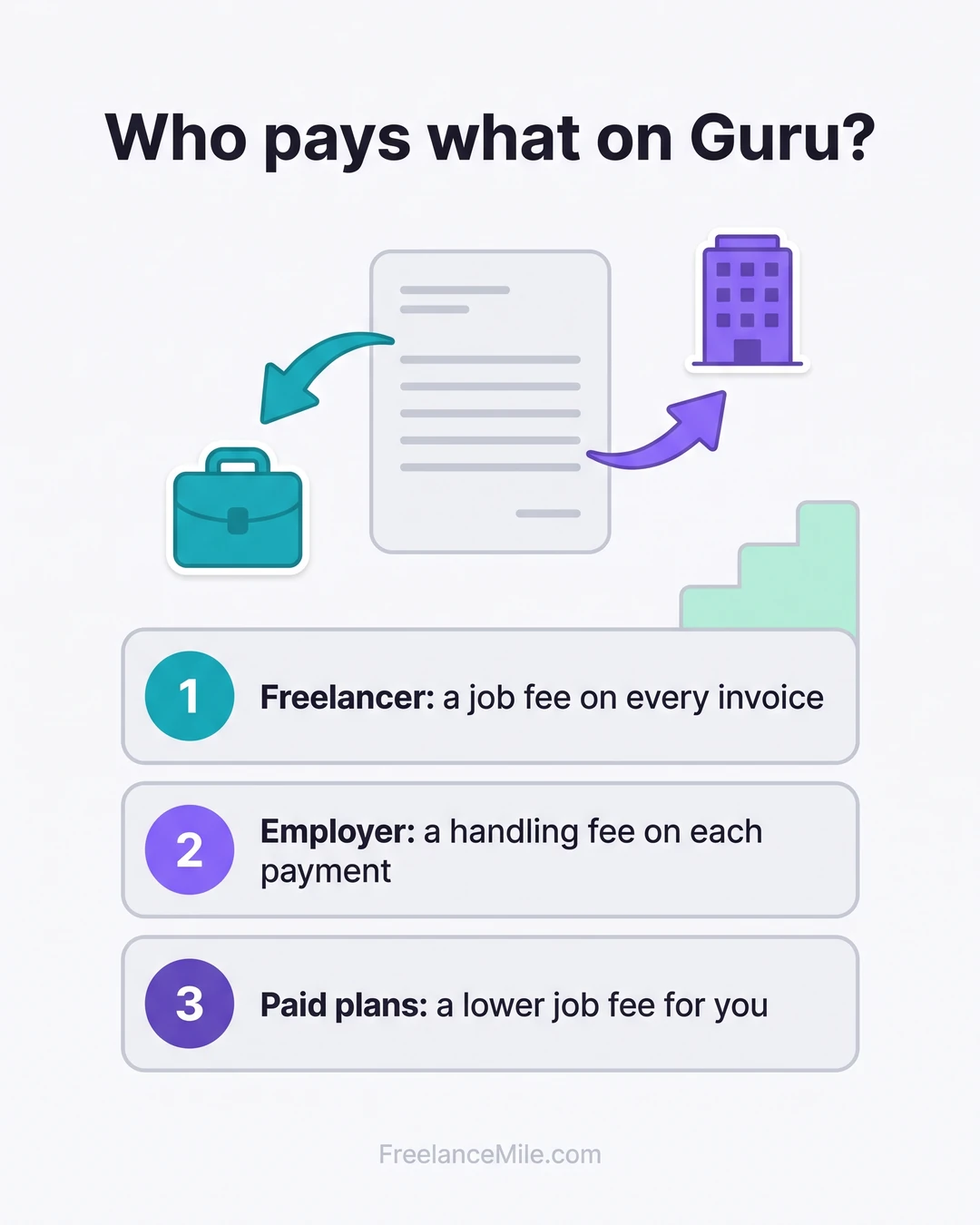
Signing up, posting jobs and searching for freelancers are free for employers (Guru). Freelancers pay through job fees and, optionally, a membership.
What are the steps to get hired on Guru?
- Create a profile with your services, rates and portfolio.
- Find a job you fit and send a Quote, which costs one or more Bids.
- Agree on the terms with the employer once they hire you.
- Do the work and send an invoice through Guru.
- Ask the employer to release the funds held in SafePay to your account.
If an employer doesn’t respond to a release request within 7 days, Guru releases the funds automatically. If you disagree on the work, funds in SafePay can go to arbitration (Guru).
How much does Guru charge freelancers?
Guru takes a job fee from every invoice you’re paid, and the rate depends on your plan. The free Basic plan charges 9%, and the Executive plan charges 5% (Guru pricing).
Scroll sideways to see the full table.
| Plan | Price (billed monthly) | Job fee | Bids per month |
|---|---|---|---|
| Basic | Free | 9% | 10 |
| Basic+ | $11.95 | 9% | 50 |
| Professional | $21.95 | 7% | 50 |
| Business | $33.95 | 6% | 50 |
| Executive | $49.95 | 5% | 50 |
Guru says you can save up to 27% by paying for a plan yearly. Memberships are non-refundable, and if one expires, your account drops back to Basic.
Can the employer pay part of your job fee?
Yes. An employer can cover up to 5% of your job fee. On the Executive plan, that brings your fee to zero (Guru).
It’s worth asking about this when you agree on terms, especially on bigger projects.
What else do paid plans add?
- More Bids, plus a yearly rollover of unused Bids: 100 on Professional, 200 on Business and 300 on Executive. Basic and Basic+ get no rollover.
- Premium Quotes and Sales Messages, which cost extra Bids. On Professional, Business and Executive, a Premium Quote costs 6, 5 or 4 Bids and a Sales Message costs 5, 4 or 3 Bids.
- Direct messages to employers, which only paying members can send (Guru pricing).
If you’re testing Guru, start on Basic. Upgrade only once Quotes start turning into paid work.
How much does Guru charge employers?
Employers pay a 2.9% handling fee on the value of each invoice, so a $100 invoice costs $102.90. Paying by eCheck, physical check or wire transfer earns 3% instant cashback, which cancels that fee (Guru).
How do you get paid on Guru?
Once an employer releases funds, the money lands in your Guru Cash Account. From there you withdraw it with one of these methods.
Scroll sideways to see the full table.
| Method | Guru fee | Minimum | Notes |
|---|---|---|---|
| PayPal | None | $25 | PayPal may charge its own fees |
| Wire transfer | $9 per wire | $50 | For bank accounts outside the U.S. |
| Non-U.S. bank account | $1 | $100 | 48 countries, paid in local currency, up to 5 business days |
Payoneer is no longer an option. Guru stopped Payoneer withdrawals on October 5, 2023 (Guru blog).
Is Guru.com legit?
Yes, Guru is a real marketplace with payment protection built in. The protection only works if you keep the work and the money on Guru.
Be careful with anyone who asks you to move to another app, pay a fee to start, or accept payment off the platform. Those are the classic signs of a scam on any freelance site.
Guru vs Upwork vs Fiverr: which is better?
Each one works differently. Fiverr sells ready-made packages, while Upwork and Guru are built around pitching on posted jobs.
Scroll sideways to see the full table.
| Fiverr | Upwork | Guru | |
|---|---|---|---|
| How you get work | Clients order your Gigs | You send proposals | You send Quotes |
| Freelancer fee | You keep 80% | 0% to 15% | 9% (free) to 5% (paid) |
| Cost to pitch | No pitching needed | Connects, $0.15 each | 10 free Bids a month, 50 on paid plans |
| Client fee | 5.5%, plus $3.50 under $200 | 5%, plus a contract initiation fee | 2.9% handling fee |
Fiverr suits you if your service fits a fixed package. Upwork has the most job posts but costs more per pitch. Guru’s job fee is fixed by your plan, so you know your cut before you quote.
I hire and screen freelancers on Upwork myself. Ratings, recent reviews and past work drive about 80% of my decision, and the same logic applies on Guru.
Want more detail? Read is Upwork worth it, what Fiverr is and how it works, or our list of the best freelance websites.
Is Guru worth it for freelancers?
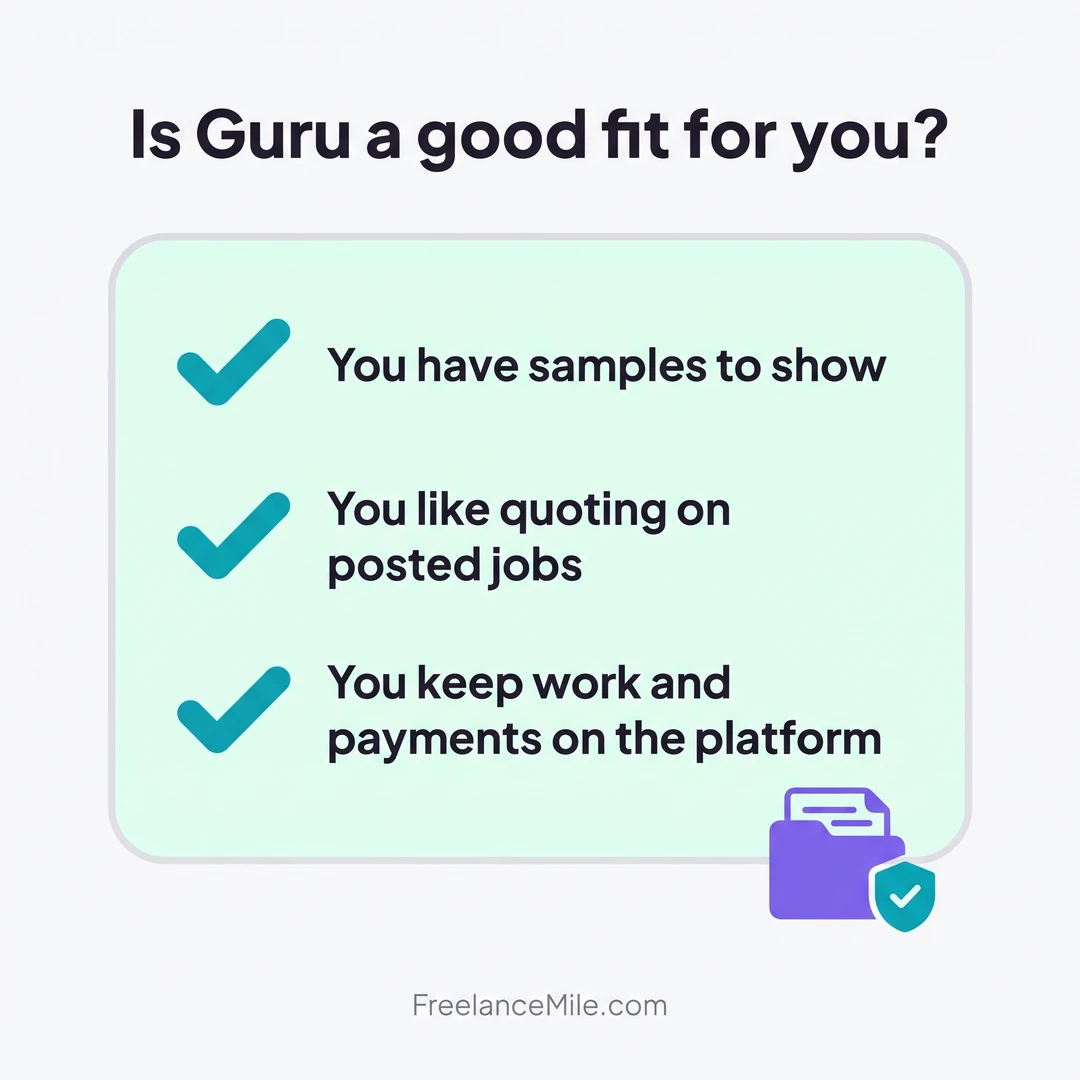
It can be, especially if you have a portfolio and prefer quoting on real jobs. The low job fee means you keep more of every invoice.
Pros of Guru
- Free to join, with 10 Bids a month to test it.
- Job fees from 9% down to 5%, and employers can cover up to 5%.
- SafePay holds funds, with automatic release after 7 days.
- Low fee withdrawals, including PayPal with no Guru fee.
Cons of Guru
- 10 Bids a month runs out fast on the free plan.
- Direct messages and Premium Quotes need a paid plan.
- Memberships are non-refundable if Guru doesn’t work out for you.
- No Payoneer withdrawals since October 2023.
How do you win work on Guru?
Treat every Bid like money, because on the free plan it nearly is. Quote only on jobs where you clearly fit.
- Show 3 to 5 samples that match the jobs you want.
- Open your Quote with the employer’s problem, not your bio.
- Give a clear price and timeline, and ask one smart question.
- Ask happy clients for reviews, since reviews win the next job.
New to this? Start with how to start freelancing with no experience, then set your prices with how much should I charge.
FAQ
Is Guru free for freelancers?
Yes. The Basic plan is free and includes 10 Bids a month, but Guru still takes a 9% job fee when you get paid.
How many Bids do you get on Guru?
Basic gives you 10 Bids a month. Every paid plan gives you 50 a month (Guru pricing).
Does Guru still support Payoneer?
No. Payoneer withdrawals ended on October 5, 2023. Use PayPal, a wire transfer, or a local bank transfer instead.
Sources (checked 30 October 2026)
- Guru: Freelancer membership pricing (plan prices, job fees, Bids, 27% annual saving)
- Guru Help: Job fee (employer can cover up to 5%)
- Guru Help: Membership (10 Quotes a month on Basic)
- Guru Help: Handling fees (2.9% employer fee, 3% cashback)
- Guru Help: Release funds (7-day response, arbitration)
- Guru Help: PayPal, wire transfer and non-U.S. bank account (withdrawal fees and minimums)
- Guru blog: Payoneer withdrawals ended October 5, 2023
- Upwork freelancer pricing and client pricing (0% to 15%, $0.15 Connects, 5% client fee)
- Fiverr Help Center: Your earnings page and Paying for orders (80% to sellers, 5.5% client fee)
What to do next
Set up a free Guru profile, add your best samples, and spend your 10 Bids on jobs you’re sure you fit. Upgrade only once Quotes start turning into paid work.