A freelance bartender works private events, weddings and parties as an independent contractor instead of working shifts for one bar. You set your own schedule and rates.
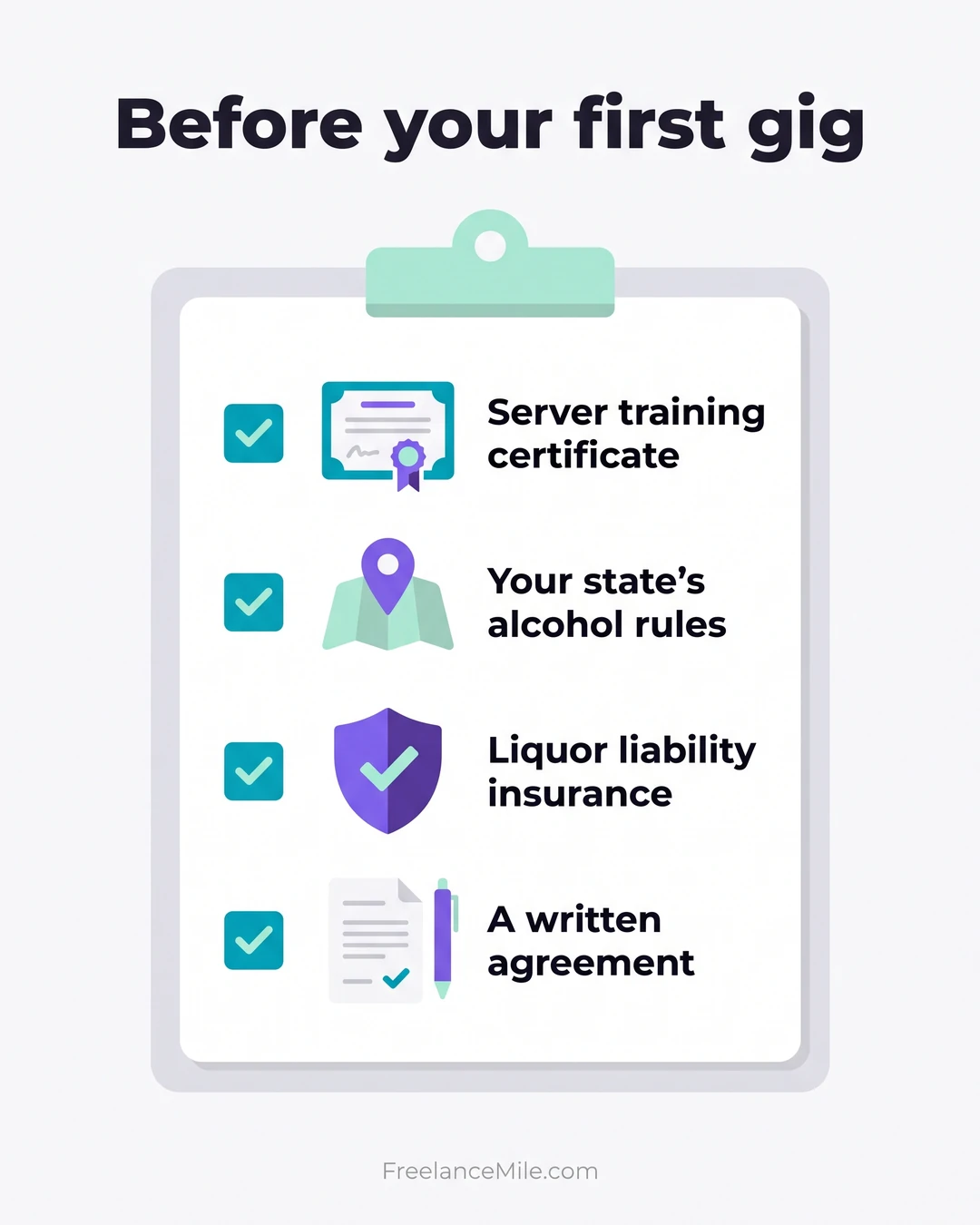
To start, you need to meet your state’s serving age, get the alcohol server training your state requires, and carry liquor liability insurance. Here’s how, step by step. If you have questions, ask in the comments below.
Key takeaways
- Pay benchmark: U.S. bartenders earned a median $16.51 an hour in May 2025, tips included, per the BLS. That figure covers employees, not the self-employed.
- Certification: rules vary by state. California and Illinois require alcohol server training; Texas leaves it to employers.
- Liquor license: in Illinois, a mobile bar that only provides bartending services doesn’t need one, but the client must supply the alcohol.
- Insurance: a general liability policy may not cover liquor liability, so ask for it separately.
- Experience: there’s no formal education requirement; most bartenders learn on the job.
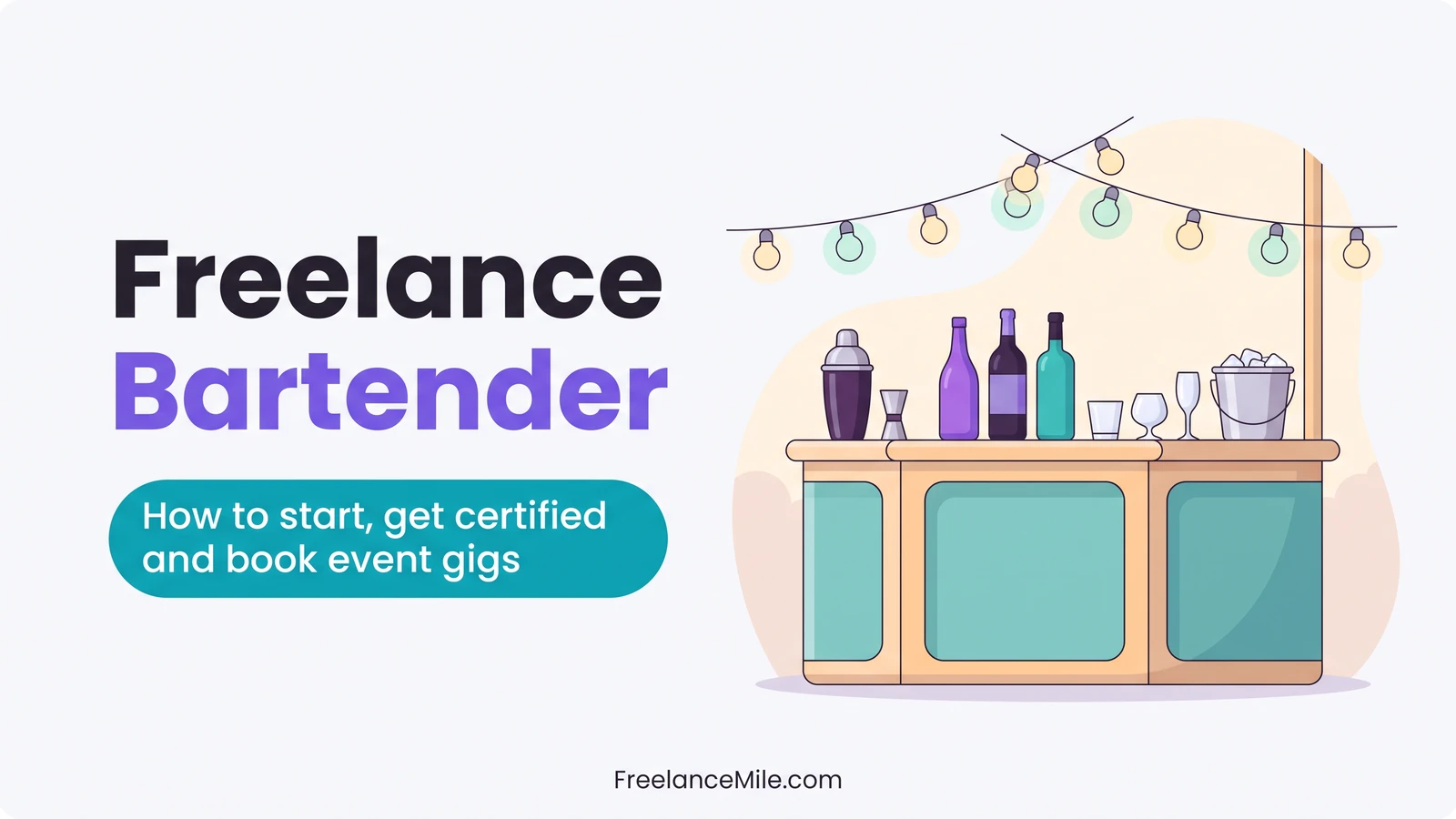
What is a freelance bartender?
A freelance bartender is a self-employed bartender hired per event. Clients include couples, party hosts, caterers, event planners and venues without their own bar staff.
It’s a form of freelancing: you find clients, quote a price, show up with your skills and kit, and get paid per gig.
How do you become a freelance bartender?
Most people start with bar experience, but the BLS says bartenders typically need no formal education and learn through short-term on-the-job training.
- Check the age rule. Most states require alcohol servers to be at least 18, according to the BLS. Check your own state’s rule.
- Get server training. Take the course your state accepts, such as TIPS, ServSafe Alcohol or a state program like California RBS or Illinois BASSET.
- Learn your state’s event rules. Find out whether you can buy alcohol for a client or whether the client must supply it.
- Set up your business. An EIN from the IRS is free. Keep gig income separate so tax time is easy.
- Get insured. Ask for general liability plus liquor liability coverage.
- Build your kit and menu. Plan a short drinks menu you can serve fast at volume.
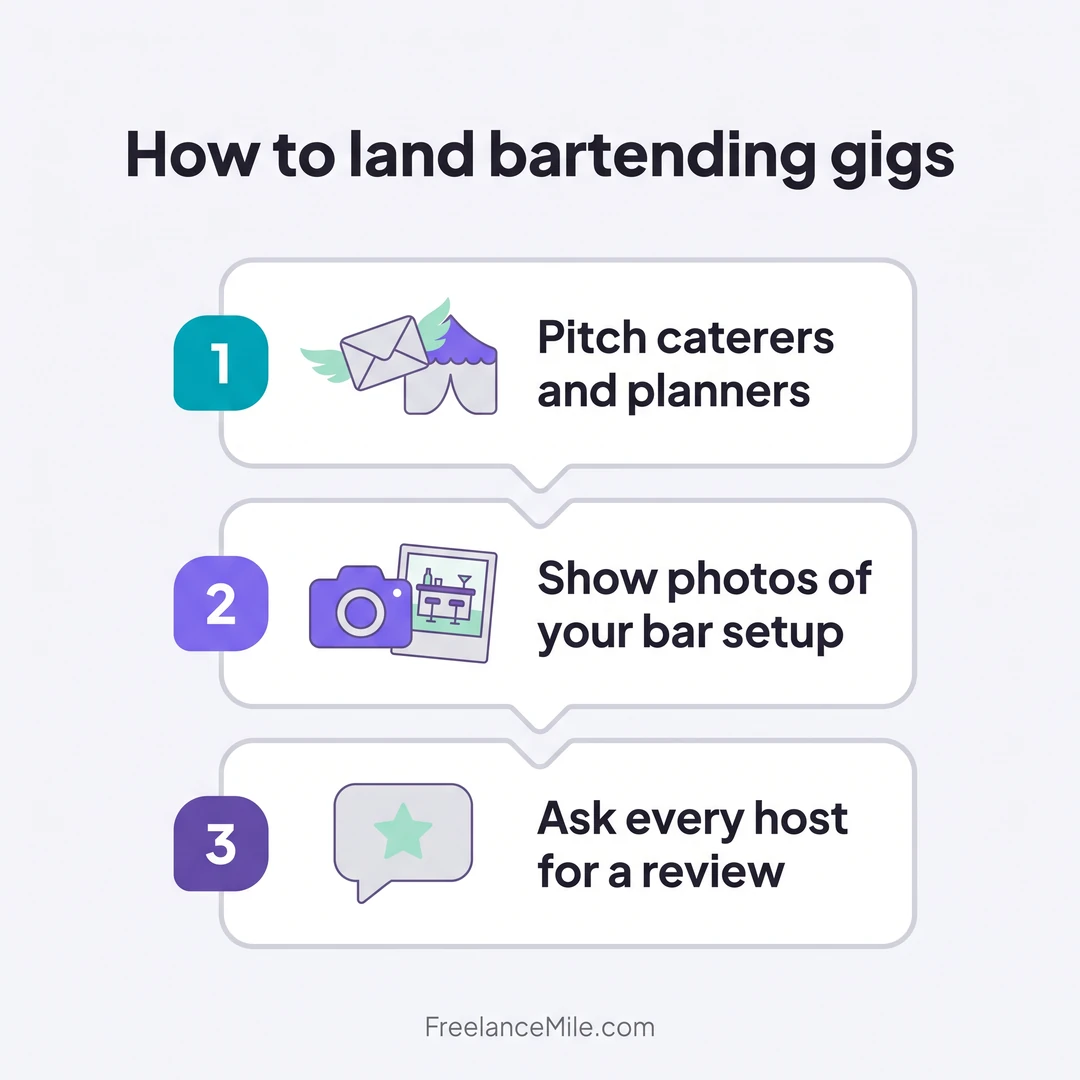
- Find your first gigs. Pitch caterers, planners and venues, and list your service locally.
Where to find freelance bartending gigs
Caterers and event planners are the best repeat clients, because they need bar staff for every event. Wedding venues without in-house staff are next.
You can also post in local listings; see my guide to Craigslist gigs near me. Many events fall on weekends, so read do freelancers work on weekends to plan your week.
How much do freelance bartenders make?
The BLS reports a median wage of $16.51 an hour, or $34,340 a year, for bartenders in May 2025 (BLS). Its wage data include tips.
The lowest 10% earned less than $9.67 an hour and the highest 10% more than $35.47. These figures don’t include self-employed bartenders.
I couldn’t find an official source for freelance event rates, so I won’t quote one. Set your price to cover prep time, travel, insurance, supplies and cleanup, not just the hours behind the bar.
Scroll sideways to see the full table.
| BLS figure (bartenders) | Value |
|---|---|
| Median hourly wage, May 2025 | $16.51 |
| Median annual wage, May 2025 | $34,340 |
| Lowest 10% / highest 10% (hourly) | Less than $9.67 / more than $35.47 |
| Jobs in 2025 | 762,600 |
| Projected growth, 2025 to 2035 | 5% |
| Openings each year (projected) | About 121,200 |
Do freelance bartenders need a license or certification?
Usually you need a server certificate, not a liquor license. Rules are set by each state, and many states or localities require a responsible-server course, per the BLS.
Scroll sideways to see the full table.
| State | Requirement | Valid for |
|---|---|---|
| California (RBS) | Mandatory since July 1, 2022 for on-premises servers and managers; certify within 60 days of starting | Three years |
| Florida (Responsible Vendor) | Voluntary. Vendors that want to qualify must train non-managerial servers within 30 days of starting and managers within 15 days | Check your course provider |
| Illinois (BASSET) | Required within 120 days of hire; bartenders at private events for mobile bars must be BASSET certified | Three years |
| New York (ATAP) | Recommended, not required. Proof of training may reduce the penalty if the SLA charges a violation | Check your course provider |
| Texas (TABC) | Not required by state law, but many employers require it | Two years |
Rules vary by state, so check your own state’s alcohol beverage control board before you take a gig.
California RBS
You register in the RBS Portal, train with an approved provider, then pass the ABC exam within 30 days of training (California ABC).
Illinois BASSET and mobile bars
Illinois says a mobile bar business that only provides bartending services doesn’t need a liquor license, but it can’t sell or buy the alcohol (Illinois Liquor Control Commission). The client supplies it.
Texas TABC
Texas doesn’t require seller-server certification by law, but TABC strongly recommends it and many employers require it (TABC). The online course takes about two hours (TABC).
National courses
TIPS offers an on-premise course for bartenders, and ServSafe Alcohol comes from the National Restaurant Association. Check which one your state or client accepts.
Do you need insurance as a freelance bartender?
Yes, you should have it. The Hartford says liquor liability isn’t included in a general liability policy and is a separate coverage you’ll need if your business serves alcohol (The Hartford).
Liquor liability can cover legal costs, settlements and medical bills if a guest you served causes harm. The Hartford notes that 43 states have dram shop laws, which let businesses be held liable for serving intoxicated people who then cause harm.
The SBA also explains the main types of business insurance and how to choose them (SBA).
Freelancing tips for bartenders
- Use a written agreement. List hours, guest count, who supplies alcohol, ice and glassware, and your cancellation terms.
- Ask about the guest list. Guest count and event length decide how much help and stock you need.
- Serve responsibly. Check IDs and cut off service when needed; your certificate training covers how.
- Take photos. Shoot your bar setup at every event for your portfolio and social media.
- Ask for reviews. Planners book bartenders that other hosts recommend.
- Track every payment. You’ll owe self-employment tax once net earnings reach $400.
What equipment does a freelance bartender need?
Start small and add as you book bigger events. The BLS notes bartenders may need to lift up to 50 pounds, so plan for carrying cases and ice.
- Shakers, jiggers, strainers, bar spoons and a muddler
- Ice scoops, cutting board, knife and garnish trays
- Bottle openers, wine keys and pour spouts
- A portable bar or folding table with a cover, if the venue has none
- Your printed certificate, insurance proof and agreement
Do freelance bartenders pay taxes?
Yes. In the U.S., you owe self-employment tax if your net earnings from self-employment are $400 or more (IRS). The rate is 15.3% for Social Security and Medicare (IRS).
An EIN is free; the IRS says you never have to pay a fee for one (IRS). For more ways to earn on weekends, see weekend side hustles.
FAQ
Do I need a liquor license to be a freelance bartender?
Usually not if the client buys the alcohol. In Illinois, a bartending-only mobile bar doesn’t need a liquor license but can’t sell or buy alcohol. Check your state’s rules.
How old do you have to be to bartend at events?
Most states require alcohol servers to be at least 18, per the BLS. Check your state agency for the exact rule.
Can I become a freelance bartender with no experience?
Yes, but it’s harder. Bartenders typically need no formal education, so get certified, practice a short menu and work a few events alongside an experienced bartender first.
Is a TIPS or ServSafe certificate valid in every state?
No. Some states require their own program, like California RBS or Illinois BASSET. Confirm which course your state accepts before you pay for one.
Is there demand for bartenders?
The BLS projects 5% growth for bartenders from 2025 to 2035, with about 121,200 openings each year. For food-related side work, see food side hustles.
Sources (checked 1 November 2026)
- BLS: Bartenders, Occupational Outlook Handbook (May 2025 pay incl. tips, age, training, outlook)
- California ABC: Responsible Beverage Service Training (mandatory, 60 days, 3 years)
- Illinois Liquor Control Commission: Q2 2024 newsletter (mobile bars, BASSET)
- Florida Statutes 561.705: Responsible vendor qualification (voluntary, 30 and 15 days)
- New York SLA: Alcohol Training Awareness Program (recommended, may reduce penalties)
- TABC: Certification FAQs and TABC certification (voluntary, 2 years, about two hours)
- TIPS and ServSafe Alcohol
- The Hartford: Liquor liability insurance
- SBA: Get business insurance
- IRS: Get an EIN, IRS Topic 554 and IRS: Self-employment tax
What to do next
Look up your state’s alcohol server rules today and book the course it accepts. Then get a liquor liability quote and pitch three local caterers or planners.