
The best jobs for pregnant women let you sit, take breaks and control your hours. Good options include virtual assistant, customer service, writing, translation, bookkeeping and medical records work, and several can be done from home.
Below are 10 jobs with their latest U.S. median pay, the work to avoid while pregnant, and the rights you have at work. If you have questions, ask in the comments below.
Key takeaways
- Look for: seated work, flexible breaks and hours you can adjust as your pregnancy progresses.
- Top pay on this list: writers earned a median $76,910 a year in May 2025.
- Avoid or adjust: heavy lifting, frequent bending and standing for 3 hours or more.
- Your rights: employers with 15 or more workers must make reasonable accommodations under the PWFA.
- Leave: FMLA gives eligible workers up to 12 weeks of unpaid, job-protected leave.
What makes a job good for pregnant women?
A good job during pregnancy is one with low physical strain. The CDC says prolonged standing and heavy lifting might raise the chance of miscarriage or preterm birth (CDC/NIOSH).
So look for work you can do sitting down, with breaks when you need them. Remote or part-time options are a bonus, because they bend around appointments and tired days.
Every pregnancy is different. Talk to your doctor about your job’s physical demands before you change anything.
What are the best jobs for pregnant women?
These 10 jobs are mostly desk-based and need no heavy lifting. Pay is the U.S. median from the Bureau of Labor Statistics for May 2025.
Scroll sideways to see the full table.
| Job | Median pay (May 2025) | Typical entry education |
|---|---|---|
| Virtual or administrative assistant | $48,310 a year | High school diploma |
| Customer service representative | $21.53 an hour | High school diploma |
| Writer | $76,910 a year | Bachelor’s degree |
| Translator | $60,170 a year | Bachelor’s degree |
| Bookkeeping clerk | $50,670 a year | Some college, no degree |
| Medical records specialist | $51,140 a year | Postsecondary nondegree award |
| Medical transcriptionist | $40,410 a year | Postsecondary nondegree award |
| Paralegal | $62,890 a year | Associate’s degree |
| Receptionist | $38,010 a year | High school diploma |
| General office clerk | $45,010 a year | High school diploma |
BLS pay figures cover employees only, not the self-employed. Freelance rates can be higher or lower.
1. Virtual or administrative assistant
You manage emails, calendars, documents and bookings, almost all from a desk. The BLS notes that some administrative assistants work from home as virtual assistants (BLS).
2. Customer service representative
You answer customer questions by phone, chat or email. The BLS says working from home is possible at some companies, and some reps work part time (BLS).
Ask about call targets and shift times first, since some roles include evenings or weekends.
3. Writer
Writers draft articles, website copy, product descriptions and more. About 65% are self-employed, and many can work anywhere with a computer (BLS).
If you want to freelance, see how to start freelancing with no experience.
4. Translator
If you’re fluent in two languages, translation is quiet, focused desk work. Part-time work is common, and translators can often work remotely (BLS).
5. Bookkeeping clerk
You record transactions, track invoices and keep the books in order for a business. It’s detailed, seated work with a median of $50,670 a year (BLS).
6. Medical records specialist
You compile and organize patient files in health records systems. It suits you if you like healthcare but want to skip patient-facing physical work (BLS).
7. Medical transcriptionist
You turn doctors’ voice recordings into written reports. It’s a computer-based job with a median of $40,410 a year (BLS).
8. Paralegal
Paralegals research cases, draft documents and organize files for lawyers. It’s the second best-paid job on this list (BLS).
9. Receptionist
Receptionists greet visitors, answer phones and schedule appointments. If the role has you standing, a stool or chair is one of the accommodations the EEOC lists.
10. General office clerk
Office clerks file records, answer phones and type documents. It’s an easy-to-enter desk job with a median of $45,010 a year (BLS).
For more options, see work from home jobs that provide equipment and high-paying jobs with no experience.
Which jobs should you avoid or adjust while pregnant?
Jobs with high physical demands are the ones to discuss with your doctor. The CDC lists these as examples (CDC/NIOSH):
- Healthcare workers
- Manufacturing and construction workers
- Service workers and flight attendants
- Firefighters and law enforcement officers
- Childcare providers and teachers
- Farm workers
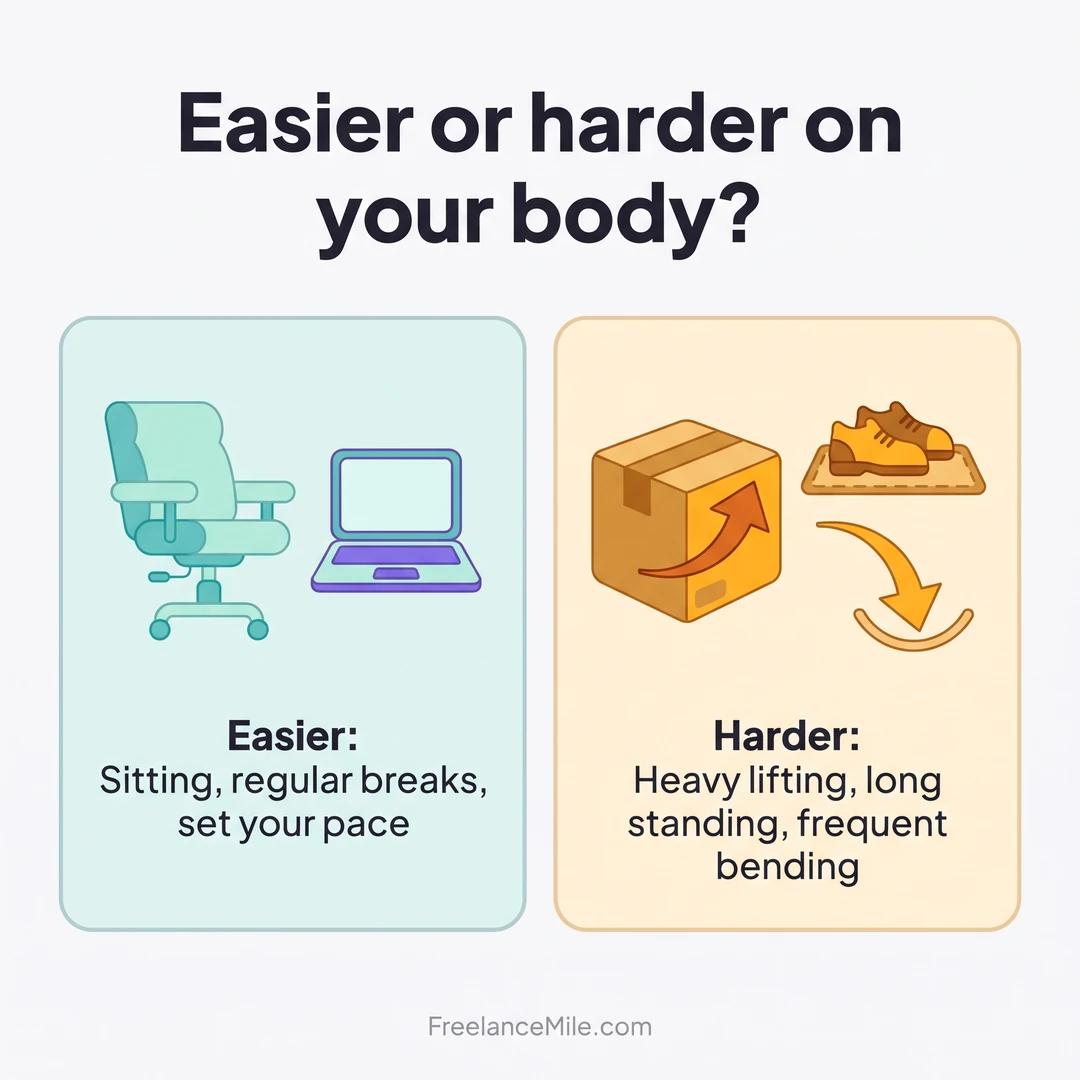
You don’t always have to quit. The CDC suggests cutting back on frequent stooping or bending, lifting heavy objects from the floor or overhead, and standing for 3 hours or more.
Sitting during breaks helps too. If your job makes that hard, ask for an accommodation.
What are your rights at work while pregnant?
In the U.S., the Pregnant Workers Fairness Act took effect on June 27, 2023. It requires employers with 15 or more employees to make reasonable accommodations, unless that causes undue hardship (EEOC).
What accommodations can you ask for?
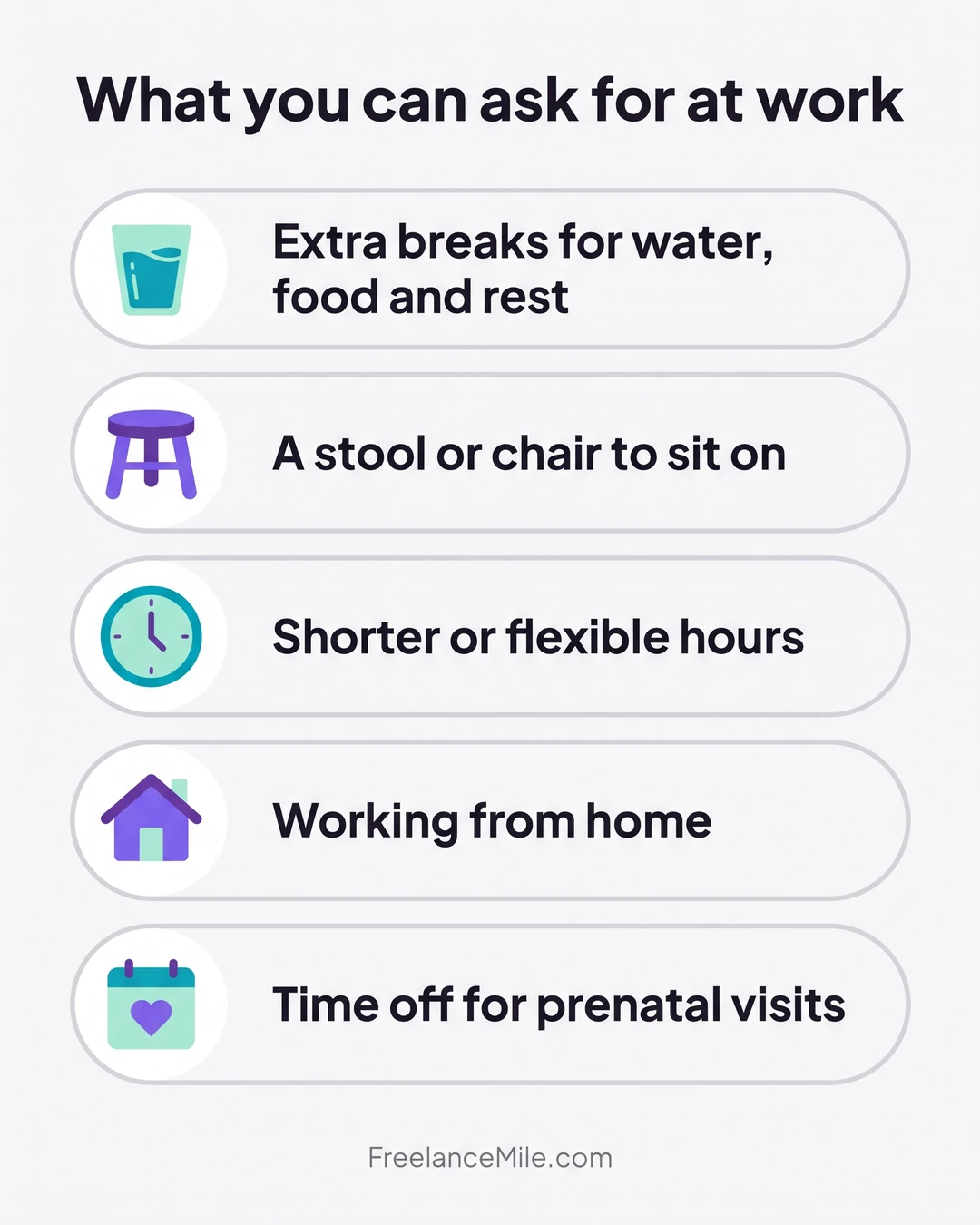
The EEOC lists examples like these:
- More flexible breaks to drink water, eat, rest or use the restroom
- A stool or chair to sit on
- Shorter hours, part-time work or a later start time
- Telework
- Light duty or help with lifting
- Time off for health care appointments and to recover from childbirth
Your employer can’t force you to take leave if another accommodation lets you keep working. ACOG notes the law covers prenatal appointments even for workers who don’t qualify for FMLA (ACOG).
Can you be fired for being pregnant?
Not legally. Title VII bans pregnancy discrimination against employees and job applicants, and the PWFA and ADA add more protections (EEOC). More than 30 states and cities have their own pregnancy laws too.
How much leave do you get?
The FMLA gives eligible workers up to 12 workweeks of unpaid, job-protected leave in 12 months for the birth and care of a newborn. Your health insurance continues during that leave (U.S. Department of Labor).
To qualify, you need 12 months with your employer, 1,250 hours worked in the past year, and 50 employees within 75 miles of your worksite.
Outside the U.S., check your own country’s rules, since these laws are federal U.S. protections.
Can you start freelancing while pregnant?
Yes, and many people do because you set your own hours. The trade-off is that freelancers don’t get employer-paid leave or workplace accommodations.
If you plan to freelance, start a few months early. When I hire freelancers on Upwork, ratings, recent reviews and past work drive about 80% of my decision.
A few good reviews before your due date make it easier to pick work back up later. Compare platforms in our list of the best freelance websites, or see remote jobs with no interview.
FAQ
What is the easiest job while pregnant?
Seated desk jobs like general office clerk, receptionist or virtual assistant are usually the easiest. They need no heavy lifting and little standing.
Can you ask to work from home while pregnant?
Yes. Telework is one of the accommodations the EEOC lists under the PWFA, if your employer has 15 or more employees.
Should you change jobs while pregnant?
Only if your current role is physically demanding and can’t be adjusted. Ask for accommodations first, since a new job may not offer FMLA leave for 12 months.
Sources (checked 30 October 2026)
- EEOC: What you should know about the Pregnant Workers Fairness Act (15+ employees, accommodation examples)
- EEOC: Pregnancy discrimination
- U.S. Department of Labor: Family and Medical Leave Act (12 workweeks, eligibility)
- CDC/NIOSH: Physical demands and pregnancy (lifting, standing, high-demand jobs)
- ACOG: Pregnant and breastfeeding patients’ rights and protections
- BLS: Secretaries and administrative assistants (May 2025 pay, plus similar occupations)
- BLS: Customer service representatives, Writers and authors and Interpreters and translators
What to do next
Pick two jobs from the table that match your skills and talk to your doctor about your current work. If you’re employed, write down the accommodations you need and send them to your manager or HR.