
Yes – several U.S. careers pay well without a bachelor’s degree. Median wages below come from the Bureau of Labor Statistics May 2025 data.
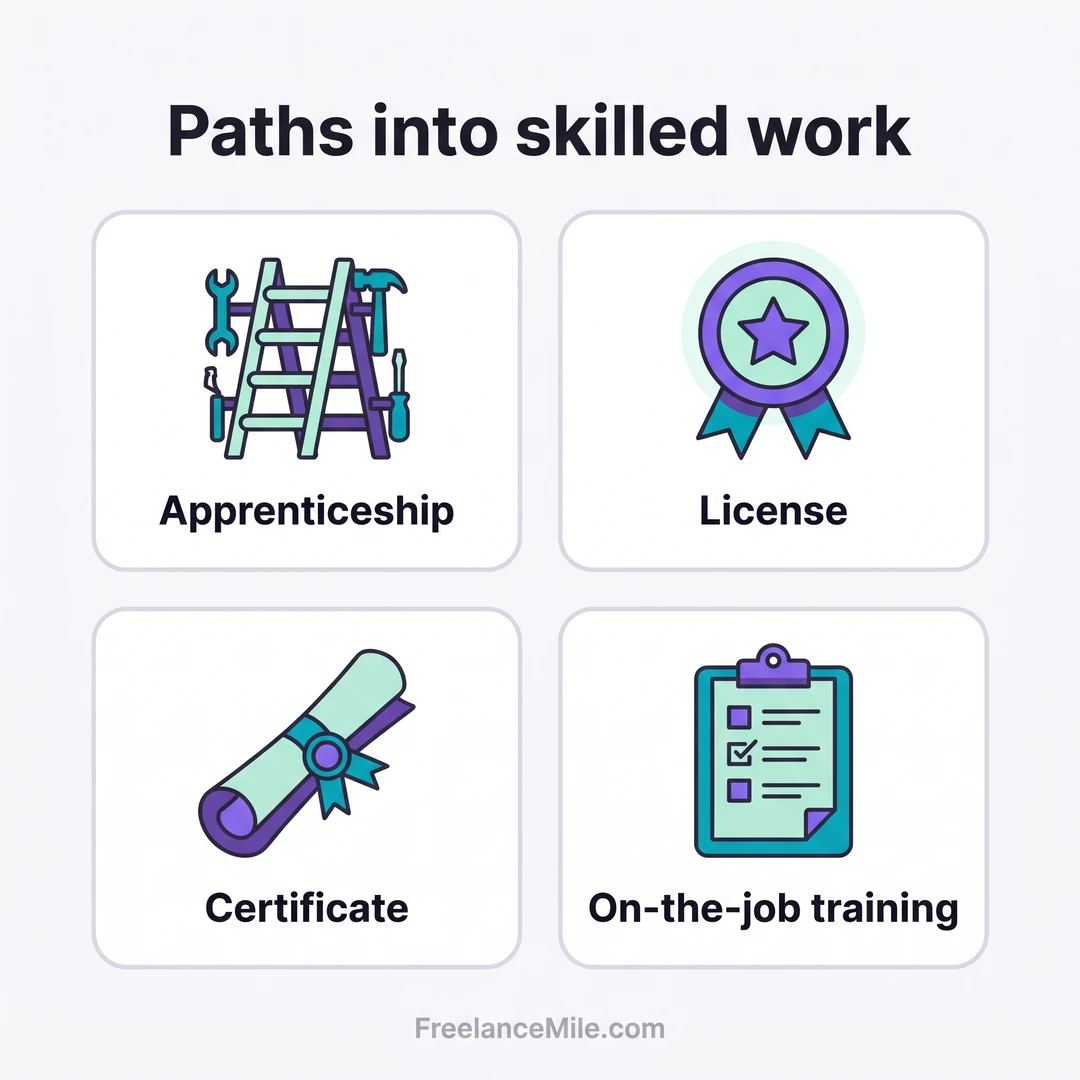
Most of these paths still need a license, apprenticeship, certificate or on-the-job training. “No experience” means no degree requirement, not zero training.
Key takeaways
- Median pay is not a guarantee. Figures are national medians from BLS May 2025; your city and employer can pay more or less.
- Training still matters. Apprenticeships, CDL, state licenses and short certificates open the higher-paying roles.
- Watch for job scams. Never pay to get hired. Ignore unexpected texts that ask you to reply “YES” about a remote job.
- Freelance is another path. Skills-based work without a degree is covered in how to start freelancing with no experience.
- Check the source. Every pay number below links to its BLS Occupational Outlook page.
What are high paying jobs with no experience?
High paying jobs with no bachelor’s degree are roles where BLS lists a high school diploma, a postsecondary nondegree award, or an apprenticeship as the typical entry path – and the median wage still clears about $50,000 a year.
“No experience” in search queries usually means you do not need a four-year degree. Employers still expect training, licensing or paid apprenticeships for most of the careers on this list.
If you are comparing remote options that supply gear, see work from home jobs that provide equipment.
How much do high salary jobs with no degree pay?
On this list, May 2025 BLS medians run from about $52,830 for real estate sales agents up to $109,910 for elevator and escalator installers and repairers.
Medians sit in the middle of the pay range. Half of workers earn more, half earn less. Overtime, tips, commissions and location shift take-home pay a lot.
15 high earning jobs you can start without a bachelor’s degree
Each career below uses BLS May 2025 median annual pay and the typical education BLS lists for entry. Links go to the official Occupational Outlook Handbook pages opened on 5 November 2026.
Scroll sideways to see the full table.
| Career | Median pay (May 2025) | Typical entry |
|---|---|---|
| Elevator and escalator installers and repairers | $109,910 | High school diploma, then a multi-year apprenticeship |
| Aircraft and avionics equipment mechanics and technicians | $80,180 | Postsecondary nondegree award (often an FAA-approved program) |
| Claims adjusters, examiners, and investigators | $78,000 | High school diploma; some employers prefer related experience or a license |
| Real estate brokers | $73,220 | High school diploma plus a broker license (usually after working as an agent) |
| Wholesale and manufacturing sales representatives (nontechnical) | $72,080 | High school diploma; sales experience helps |
| Advertising sales agents | $64,820 | High school diploma |
| Wind turbine technicians | $64,120 | Postsecondary nondegree award |
| Plumbers, pipefitters, and steamfitters | $63,800 | High school diploma, then apprenticeship |
| Flight attendants | $63,580 | High school diploma; airline training after hire; customer-service experience helps |
| Electricians | $63,190 | High school diploma, then apprenticeship |
| Insurance sales agents | $62,280 | High school diploma plus a state insurance license |
| Computer user support specialists | $61,860 | Varies; often a high school diploma plus certificates or related training |
| Heavy and tractor-trailer truck drivers | $58,640 | Postsecondary nondegree award / CDL |
| Solar photovoltaic installers | $53,140 | High school diploma; on-the-job or short training |
| Real estate sales agents | $52,830 | High school diploma plus a state real estate license |
1. Elevator and escalator installers and repairers
Median pay: $109,910 (BLS May 2025).
Typical entry: High school diploma, then a multi-year apprenticeship.
One of the highest-paying trades BLS tracks. The $109,910 median (May 2025) comes from the official BLS elevator and escalator installers page. Expect a long apprenticeship. Source: BLS Occupational Outlook Handbook.
2. Aircraft and avionics equipment mechanics and technicians
Median pay: $80,180 (BLS May 2025).
Typical entry: Postsecondary nondegree award (often an FAA-approved program).
Median pay is $80,180. Many start with a certificate program and FAA credentials rather than a bachelor’s. Source figure listed on BLS similar-occupations tables; confirm details on BLS Occupational Outlook Handbook.
3. Claims adjusters, examiners, and investigators
Median pay: $78,000 (BLS May 2025).
Typical entry: High school diploma; some employers prefer related experience or a license.
Median annual wage is $78,000. You investigate insurance claims and decide what the company should pay. Training is often on the job. See BLS Occupational Outlook Handbook.
4. Real estate brokers
Median pay: $73,220 (BLS May 2025).
Typical entry: High school diploma plus a broker license (usually after working as an agent).
Brokers’ median pay is $73,220. This is not a first no-experience job: a broker license usually requires prior experience as a real estate agent, then extra state experience hours. Details: BLS Occupational Outlook Handbook.
5. Wholesale and manufacturing sales representatives (nontechnical)
Median pay: $72,080 (BLS May 2025).
Typical entry: High school diploma; sales experience helps.
Nontechnical wholesale sales reps earn a $72,080 median. Pay often mixes salary and commission. See BLS Occupational Outlook Handbook.
6. Advertising sales agents
Median pay: $64,820 (BLS May 2025).
Typical entry: High school diploma.
Median pay is $64,820. You sell ad space or airtime. Commission is common, so income varies with deals closed. Source: BLS Occupational Outlook Handbook.
7. Wind turbine technicians
Median pay: $64,120 (BLS May 2025).
Typical entry: Postsecondary nondegree award.
Median wage is $64,120. Most complete a certificate or associate-level technical program and then climb towers for maintenance. See BLS Occupational Outlook Handbook.
8. Plumbers, pipefitters, and steamfitters
Median pay: $63,800 (BLS May 2025).
Typical entry: High school diploma, then apprenticeship.
Median pay is $63,800. Paid apprenticeships teach the trade while you earn. Licensing rules vary by state. Source: BLS Occupational Outlook Handbook.
9. Flight attendants
Median pay: $63,580 (BLS May 2025).
Typical entry: High school diploma; airline training after hire; customer-service experience helps.
Median annual wage is $63,580. Airlines run their own training programs after you are hired. Schedules and bases affect lifestyle. See BLS Occupational Outlook Handbook.
10. Electricians
Median pay: $63,190 (BLS May 2025).
Typical entry: High school diploma, then apprenticeship.
Median pay is $63,190. Apprenticeships mix paid work with classroom hours. State licensing is common. Source: BLS Occupational Outlook Handbook.
11. Insurance sales agents
Median pay: $62,280 (BLS May 2025).
Typical entry: High school diploma plus a state insurance license.
Median wage is $62,280. You need a state license before you sell. Commission structures differ by carrier. See BLS Occupational Outlook Handbook.
12. Computer user support specialists
Median pay: $61,860 (BLS May 2025).
Typical entry: Varies; often a high school diploma plus certificates or related training.
User support specialists have a $61,860 median. Help-desk certificates and clear troubleshooting skills matter more than a degree for many openings. Source: BLS Occupational Outlook Handbook.
13. Heavy and tractor-trailer truck drivers
Median pay: $58,640 (BLS May 2025).
Typical entry: Postsecondary nondegree award / CDL.
Median pay is $58,640. You need a commercial driver’s license. Training programs are shorter than a degree. See BLS Occupational Outlook Handbook.
14. Solar photovoltaic installers
Median pay: $53,140 (BLS May 2025).
Typical entry: High school diploma; on-the-job or short training.
Median wage is $53,140. Growth depends on local solar demand and weather. Details: BLS Occupational Outlook Handbook.
15. Real estate sales agents
Median pay: $52,830 (BLS May 2025).
Typical entry: High school diploma plus a state real estate license.
Sales agents’ median is $52,830. Income is mostly commission. You complete pre-license hours, pass the exam, then join a brokerage. Source: BLS Occupational Outlook Handbook.
Which high income jobs need a license or apprenticeship?
Trades such as electricians, plumbers and elevator installers usually require multi-year apprenticeships. Insurance, real estate and many trucking jobs need a state or federal license or CDL before you can work.
Flight attendants and many sales roles train you after hire. Always read the BLS “How to Become One” section for the career you want.
Can teens get high paying jobs with no experience?
Most careers on this list require you to be 18 (or older for CDL and some airline rules). Teens can build skills with entry retail, food service, or junior freelance work first.
For age-friendly ideas, see freelance jobs for teens.
Is freelancing a high paying path with no degree?
Freelancing does not guarantee a high salary, but it lets you sell a skill without a degree. Earnings depend on niche, rates and how consistently you land clients.
Start with what freelancing is, then how to start with no experience. Broader side-income ideas live in side hustles 101.
How do you avoid high paying job scams?
Never pay anyone to “guarantee” a job, buy a starter kit, or cash a check and wire money back. Real employers do not hire you by unexpected text and ask you to reply YES.
Verify openings on the company’s own careers page. For tax rules on gig and side work, see the IRS gig economy tax center. Career search tools: CareerOneStop.
FAQ
What is the highest paying job with no experience?
Among the BLS-backed roles on this page, elevator and escalator installers and repairers show the highest median ($109,910, May 2025). That path still needs a serious apprenticeship.
Do high salary jobs without a degree still need training?
Yes. Licenses, CDLs, apprenticeships and short technical programs are the usual gate. “No bachelor’s” is not the same as “walk in tomorrow.”
Are these high earning jobs available everywhere in the U.S.?
Demand and pay vary by metro area. Oil, solar, logistics and tourism regions skew certain trades. Check state licensing boards and local job boards.
Can I reach high income with only online work and no experience?
Some support and sales roles are remote, but competition is high and pay varies. Treat big “make $10k/month from home” ads as red flags until you verify the employer.
Where should I check official pay data?
Use the BLS Occupational Outlook Handbook for median wages and typical education. Figures on this page were checked on 5 November 2026.