
Disclosure: Fiverr is a FreelanceMile partner, and that partnership affects where it appears in this guide. Some links are affiliate links, so I may earn a commission at no extra cost to you. The pros, cons and fees for every platform, including Fiverr, are my honest take.
The easiest no interview remote jobs are freelance gigs on Fiverr, transcription (Scribie, TranscribeMe, Rev), and AI data and search rating work (CrowdGen by Appen, OneForma, TELUS Digital, RWS TrainAI, DataAnnotation).
You can also try website testing (UserTesting, Testlio), microtasks and research studies (Clickworker, Prolific), online English tutoring (Cambly), and projects on Upwork.
None of them requires a live job interview. Instead, you pass a test, record a short video, verify your ID, or get picked from your profile.
Key takeaways
- “No interview” doesn’t mean no screening. Almost every option here swaps the interview for a test, a sample task or a profile review.
- On Fiverr, your profile is the interview. Ratings, recent reviews and past work do the talking.
- Transcription is the most direct start. Scribie and TranscribeMe let you apply with a test file or entrance exam, no call needed.
- Expect waitlists at some big names. As of October 2026, Rev, Prolific, Cambly and DataAnnotation are slow or limited for new people.
- Upwork comes last for a reason. It is mostly bid-based, so you send proposals, though clients can invite and hire you directly.
What does “no interview” really mean?
A no interview remote job is one where nobody sits you down for a live call to ask about your strengths and weaknesses.
The company still checks you. It just does it another way.
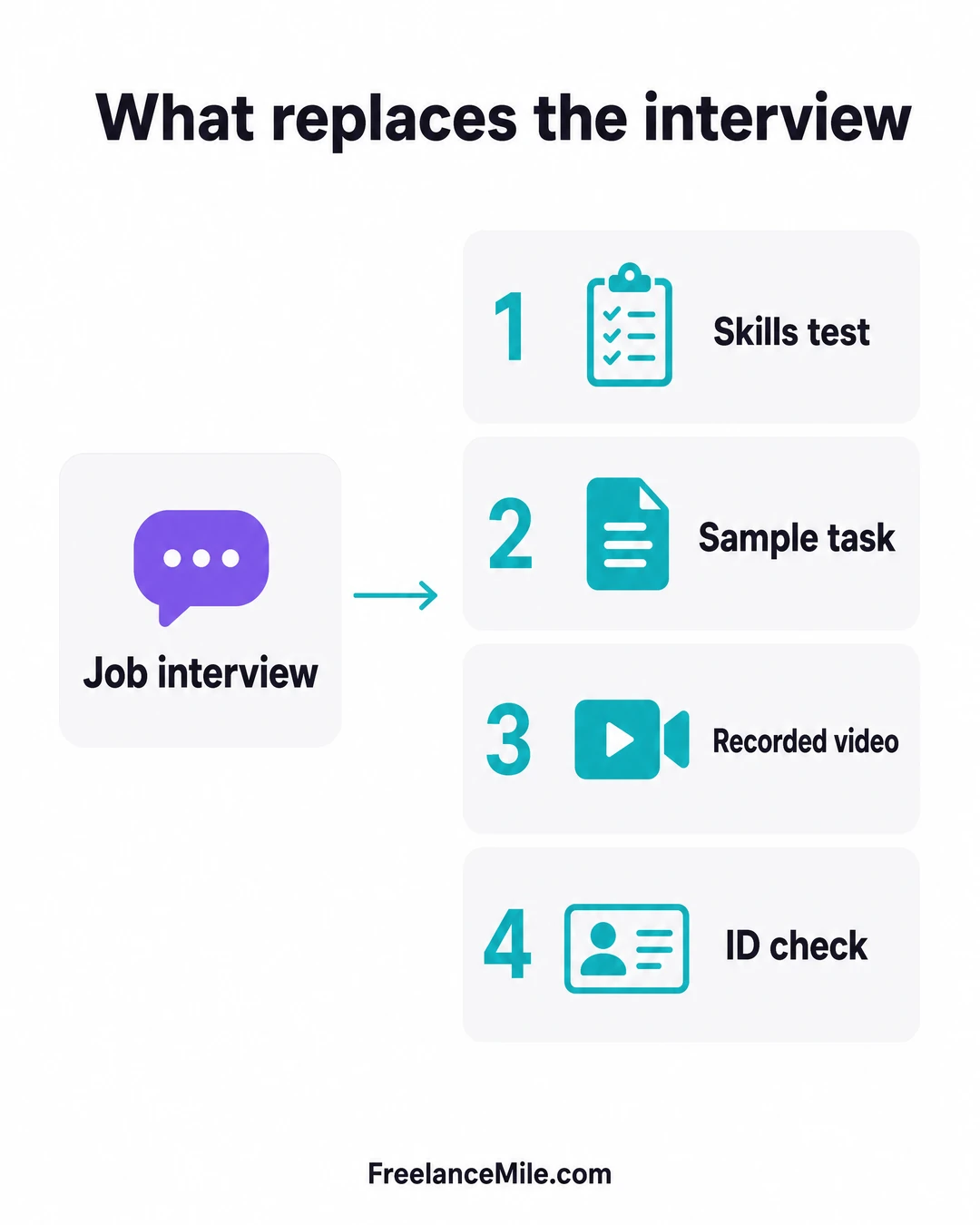
Here’s what usually replaces the interview:
- A skills test. You transcribe a short audio file, rate a few search results, or answer style guide questions.
- A sample task. You complete a practice test, like a short recorded website review.
- A recorded video. You film a short intro instead of talking to a recruiter live.
- An ID or background check. Some platforms confirm who you are and where you live.
- A profile review. On freelance marketplaces, clients read your profile, reviews and samples, then hire you.
That last one matters more than most people think. When I hire freelancers, the interview is only about 20% of my decision.
Skills, past work, feedback, experience and portfolio make up the rest. That’s about 80% of my decision.
So on gig sites, a strong profile does the job an interview would.
Is remote work still common?
Yes, but it’s competitive. The U.S. Bureau of Labor Statistics found that 22.6% of workers teleworked in March 2026.
For workers ages 16 to 24, it was only 6.7%, so beginners often have to start with test-based gig work like the jobs below.
Gallup’s Hybrid Work Indicator shows 52% of remote-capable U.S. employees work hybrid and 26% work exclusively remote.
Freelancing is big too. Upwork’s own research (so keep the source in mind) says 38% of U.S. skilled knowledge workers freelanced in 2026, up from 28% in 2025.
Quick comparison: 15 no interview remote jobs
Pay changes often. Where the company doesn’t publish a clear rate, check current pricing on the official page.
| # | Job type | Company | What replaces the interview | Pay | Who can apply |
|---|---|---|---|---|---|
| 1 | Freelance gigs | Fiverr | Profile and gig review, phone verification | Check current pricing | Most countries |
| 2 | General transcription | Scribie | Certification steps and a short test file | Check current pricing | Anyone with a verified PayPal account |
| 3 | General transcription | TranscribeMe | English entrance exam | Starts at $15 to $22 per audio hour | Anyone with a PayPal account |
| 4 | Transcription and captions | Rev | Skills assessment and sample | $0.40 to $1.10 per minute (transcription) | Checked during application; waitlist |
| 5 | AI data projects | CrowdGen by Appen | Account verification and project qualification | Check current pricing | Varies by project and country |
| 6 | AI data and language tasks | OneForma | Profile and certification tests | Check current pricing | 100+ countries, varies by project |
| 7 | Search and ad evaluator | TELUS Digital AI Community | English test, open-book exam, ID check | Check current pricing | Country-specific listings |
| 8 | AI training data | RWS TrainAI | Sign-up, then training and tests | Check current pricing | Country-specific listings |
| 9 | Website and app tester | UserTesting | Unpaid practice test | Check current pricing | Depends on country and demand |
| 10 | Software tester | Testlio | Profile and certifications | Check current pricing | Non-sanctioned countries, 18+ |
| 11 | Microtasks and data entry | Clickworker | Registration and skill assessments | Check current pricing | Many countries |
| 12 | Research studies | Prolific | Waitlist and ID check | Minimum $8 per hour set for researchers | Most OECD countries; waitlist |
| 13 | AI chatbot rater | DataAnnotation | One-hour starter assessment | From $25 per hour for general projects, per the FAQ | Fluent English speakers; ID check required. |
| 14 | Online English tutor | Cambly | Application form and intro video | $10.20 per hour ($12 for Kids) | Native English speakers 18+; limited intake |
| 15 | Freelance projects | Upwork | Proposal or client invite, picked from your profile; a chat is optional | Check current pricing | Many countries |
15 no interview remote jobs that hire by test or profile
Each job below covers the same five things, so you can compare quickly.
1. Freelance gigs on Fiverr
What replaces the interview: You build a seller profile and post a “gig,” which is a service with a set price.
Fiverr reviews every new seller and gig, and asks you to verify your account by phone. Buyers then order straight from your gig, usually without any call.
Pay: You set your own prices. Fiverr takes a seller fee, so check current pricing on Fiverr Help before you price your gigs.
Who can apply: People in most countries, though some locations are restricted.
What users say: It isn’t instant. A user on r/Fiverr said “it could be a long wait for a first order.”
Another user in the same thread said “Fiverr is very saturated, there is an exodus of buyer clientele and a high competition of sellers fighting for the buyers left.”
The upside is real, though: no proposals, no calls, and buyers come to you.
Tip: Treat your gig page like a job interview. When I hire freelancers, I mostly look at their ratings, recent reviews and past work.
Add clear samples on day one, and ignore any “buyer” who asks you to pay or chat off the platform.
2. General transcription at Scribie
What replaces the interview: Scribie uses a step-by-step certification, and its own FAQ says there is no interview in the process.
You transcribe a test file of about six minutes. If you pass, you get certified and paid for it.
Pay: Check current pricing on the official Scribie page.
Who can apply: Anyone with a verified PayPal account that can receive money.
What users say: The best user thread I found is older (from 2017), so the process may have changed.
A user on r/beermoney said “Once approved, you are put in a queue for the transcription test where you transcribe a 6 minute file.”
Tip: Read Scribie’s guidelines before your test file. Small style mistakes cost more than slow typing.
3. General transcription at TranscribeMe
What replaces the interview: An English entrance exam. Pass it and TranscribeMe switches your account on.
Legal work needs extra exams.
Pay: TranscribeMe lists a starting rate of $15 to $22 per audio hour. Check current pricing on the official page.
Who can apply: Anyone with a PayPal account. Confirm your country on the sign-up page.
What users say: The exam is strict. This thread is older (from 2020), so details may have changed.
A user on r/Transcription said “You have to to get a score of 100% on both the Multiple Choice/Sample Sentences and Style Guide tests.”
Tip: Study the style guide like it’s the test, because it basically is. Take the exam in a quiet room with good headphones.
4. Transcription and captions at Rev
What replaces the interview: A short skills assessment and a sample task, after you pick a role.
As of October 2026, Rev says new applicants may wait a while because so many people apply.
Pay: Rev lists transcription at $0.40 to $1.10 per minute. Check current pricing for captions and other roles on the official page.
Who can apply: Rev doesn’t publish a country list. Eligibility is checked in the application.
What users say: Some people find the test confusing. A user on r/WorkOnline said “I have no idea what I’m supposed to do for this test.”
Tip: Join the waitlist, but don’t wait on Rev alone. Apply to Scribie or TranscribeMe at the same time.
5. AI data projects at CrowdGen by Appen
What replaces the interview: CrowdGen is where Appen runs its contributor sign-up.
You create an account and verify your details, then pass a qualification step for each project you want to join.
Pay: Varies by project. Check current pricing on each project listing.
Who can apply: It depends on the project and your country.
What users say: I couldn’t find a recent public user thread about CrowdGen sign-up. Read each project’s details carefully before you commit time.
Tip: Fill out your profile fully, including languages and devices. Projects often match people by those details.
6. AI data and language tasks at OneForma
What replaces the interview: You build a profile, then pass certification tests for the projects you want.
A few projects invite you to a welcome call after you apply. That is onboarding, not a hiring interview.
Pay: Set per project. Check current pricing on OneForma.
Who can apply: People in 100+ countries, but each project has its own location rules.
What users say: I couldn’t find a recent public user thread about OneForma’s tests. The official help center is the best guide for now.
Tip: Speaking a second language helps a lot here. Many projects look for specific language and country pairs.
7. Search and ad evaluator at TELUS Digital
What replaces the interview: The U.S. evaluator listing asks for an English test, an open-book exam and ID verification.
Listings are posted by country on TELUS Digital jobs.
Pay: Shown per listing, such as this U.S. evaluator role. Check current pricing on the listing.
Who can apply: There are separate listings for the U.S., UK and other countries.
What users say: Even after passing, setup can take time.
A user on r/TELUSinternational said “I personally waited until I had my credentials to log time. It took 3 weeks.”
Tip: Treat the exam like an open-book school test. Keep the guidelines open and check each answer against them.
8. AI training data at RWS TrainAI
What replaces the interview: You sign up, and the RWS recruiting team contacts you about next steps.
Training and testing then open up more projects. RWS says joining is free and you must be 18 or older.
Pay: Set per listing. Check current pricing on the RWS TrainAI community page.
Who can apply: Listings are tied to specific countries or states.
What users say: I couldn’t find a recent public user thread about RWS TrainAI. Stick to the official recruiting FAQ.
Tip: Apply only to listings that match where you live. Location mismatches are a fast way to get rejected.
9. Website and app tester at UserTesting
What replaces the interview: An unpaid practice test where you record yourself using a website and talking through your thoughts.
UserTesting reviews it, usually in about a week.
Pay: Shown on each test. Check current pricing. Payment goes to PayPal about 14 days after a test, per UserTesting’s payment FAQ.
Who can apply: It depends on your country and demand.
What users say: Getting in is quick, but tests may be slow at first.
A user on r/usertesting said “It really varies, I would expect 1 to 2 weeks, but even then it can take a while for you to start getting tests.”
Tip: Talk out loud the whole time and speak clearly. Clients pay for your thoughts, not just your clicks.
10. Software tester at Testlio
What replaces the interview: You create a profile and earn certifications through the Testlio community.
Testlio says certifications improve your chances of being matched with paid work.
Pay: Hourly, based on country tier. Check current pricing on Testlio’s support page.
Who can apply: Adults 18+ in non-sanctioned countries with PayPal or Payoneer, per Testlio’s freelancer terms.
What users say: I couldn’t find a recent public user thread about Testlio’s vetting. Read the community FAQ before you start.
Tip: Learn how to write a clear bug report. Steps to reproduce, what you expected, and what actually happened.
11. Microtasks and data entry at Clickworker
What replaces the interview: You register and take short skill assessments.
Some project types, like UHRS, need 80% on a test you can only take once.
Pay: Per task. Check current pricing on Clickworker.
Who can apply: Many countries, but sign-up is closed in some.
What users say: Payout questions come up a lot.
A user on r/Clickworker said “I have been paid just Wednesday. Are you past the minimum? Did you try a support ticket?”
Tip: Take assessments when you’re fresh. Some only give you one shot.
12. Research studies at Prolific
What replaces the interview: No test at all. You join a waitlist, then verify your ID once you’re invited.
As of October 2026, Prolific uses a waitlist for new participants.
Pay: Prolific requires researchers to pay at least $8 (£6) per hour and recommends $12 (£9).
Check current pricing on the official page.
Who can apply: People living in most OECD countries, including the U.S., UK and Canada.
What users say: The wait can be long. A user on r/ProlificAc said “it’s been just over a year now, and still on the waitlist.”
Another said “Prolific is based on demographics; when they need yours, you’ll be off the wait list.”
Tip: Sign up, then forget about it. Keep applying elsewhere while you wait.
13. AI chatbot rater at DataAnnotation
What replaces the interview: A starter assessment of about an hour, and you can only take it once.
Reddit users report long waits for a result, but the FAQ says you’ll get an email within a few days.
Pay: The DataAnnotation FAQ says general projects start at $25 per hour. Higher-skill tracks pay more.
Who can apply: Fluent English speakers; ID check required.
What users say: No news often means no.
A user on r/DataAnnotationTech said “That means you are rejected, sorry. They don’t send rejection emails.”
Tip: Give the assessment your full attention and write careful, detailed answers. You may not get a second try.
14. Online English tutor at Cambly
What replaces the interview: A short application form and a recorded intro video. Cambly’s tutor page says you don’t have to pass a live interview or a demo lesson.
Pay: Cambly lists $0.17 per minute ($10.20 per hour), or $0.20 per minute ($12 per hour) for Cambly Kids.
Check current pricing on the official page.
Who can apply: Native English speakers 18+.
As of October 2026, Cambly says it is holding back on new tutors for now, so approval may take longer.
What users say: I couldn’t find a recent public user thread I could quote. Check the official tutor page for the latest on openings.
Tip: Keep your intro video short, friendly and well lit. Smile and speak slowly.
15. Freelance projects on Upwork
What replaces the interview: Upwork is mostly bid-based. You send proposals to jobs that clients post.
Clients can also invite you to a job and hire you directly.
No live interview is required if the client picks you from your profile and proposal. Some clients may still choose to chat first.
Pay: You set your rate. Upwork charges freelancer fees and sells “Connects” for applying, so check current pricing on Upwork.
Who can apply: Freelancers in more than 180 countries use Upwork. Pick a clear niche, because crowded categories are competitive.
What users say: I couldn’t find a recent public user thread focused on getting hired without an interview on Upwork.
The /best-freelance-websites/ guide covers what to expect on the platform.
Tip: Your profile does the talking. Lead with one specific skill, show two or three strong samples, and keep proposals short and about the client’s problem.
Which no interview jobs work outside the U.S.?
Most of this list is open to U.S., UK, Canadian and Australian readers. If you live elsewhere, here’s the short version:
- Usually open worldwide: Fiverr, Scribie, OneForma, Clickworker and Upwork (with some country limits).
- Country by country: CrowdGen, TELUS Digital, RWS TrainAI, UserTesting and Testlio.
- Mostly limited: Prolific (OECD countries), DataAnnotation (fluent English speakers; ID check required) and Cambly (native English speakers).
Always check the official page for your country before you spend time on a test.
Scams that target “no interview” job searches
Scammers love this search term, because “no interview” sounds like “easy money.”
The FTC reported that job scam losses topped $220 million in the first half of 2024. Task scam reports jumped to about 20,000 in that half year, up from about 5,000 in all of 2023.
Watch for these red flags:
- A surprise job text or chat message with no clear details. The FTC says a job offer by text is probably a scam.
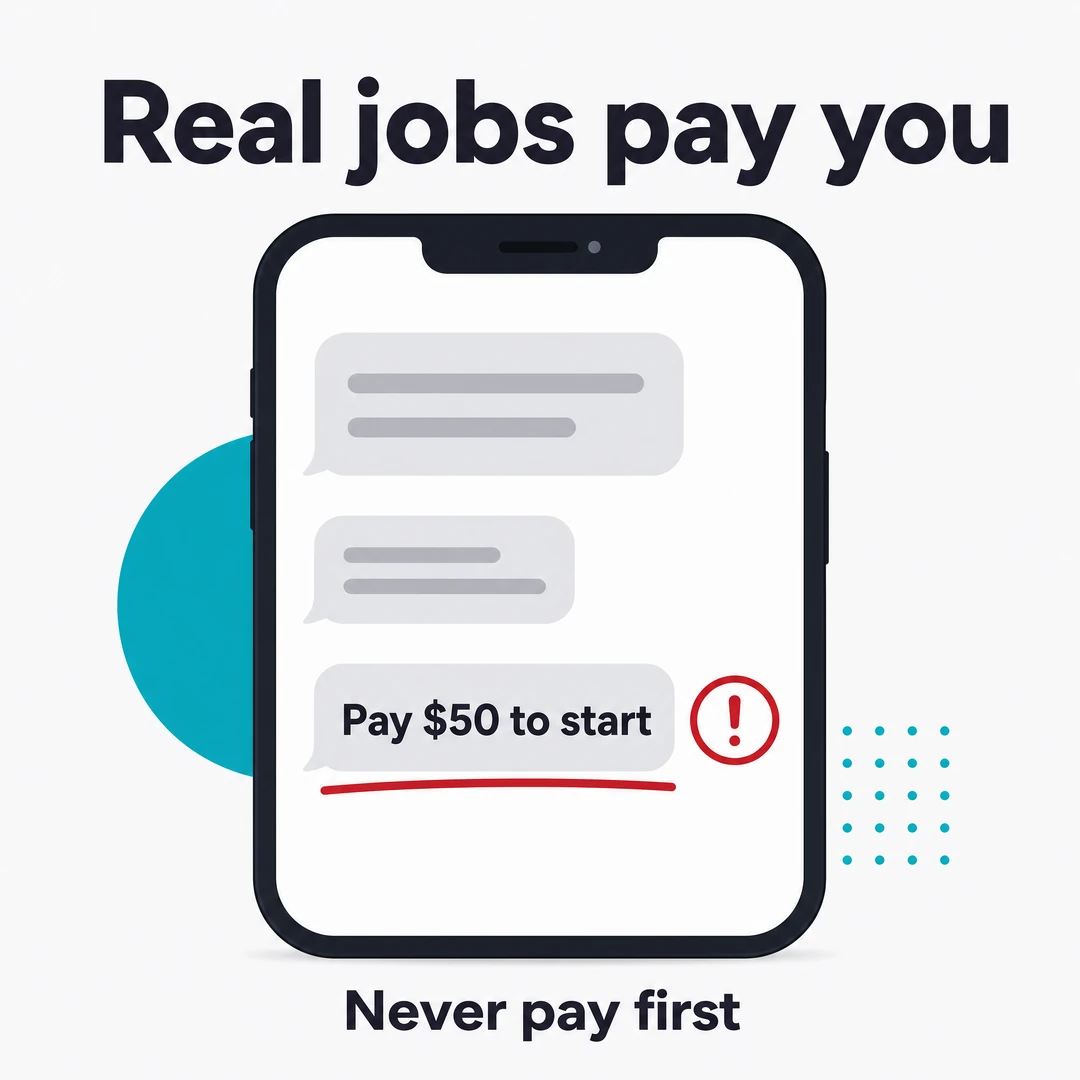
- You have to pay or deposit money to unlock tasks or withdraw earnings, often in crypto. The FBI’s IC3 warns about this pattern.
- You get paid to like, rate or “boost” products or videos. See the FTC’s guide on how to spot task scams.
- A small first payout, then requests for bigger deposits.
- A dashboard full of earnings you can’t withdraw.
- Group chats packed with “success stories.”
- Fake checks or reshipping requests. The BBB tracks employment scams like these every year.
None of the 15 platforms above charges you to apply. If anyone asks for money to “start,” walk away.
In the U.S., you can report scams to the FTC and the FBI’s IC3.
Note for global readers: India’s government has warned about the same thing.
It blocked over 100 task-based part-time job fraud websites that used WhatsApp and Telegram “tasks” to take deposits. Indian readers can report at cybercrime.gov.in or call 1930.
How to get accepted faster
- Apply to three or four platforms at once. Waitlists and silent rejections are common, so don’t bet on one.
- Prepare for the test like a school exam. Read the style guide or guidelines first, then take the test in a quiet spot.
- Use the right gear. A decent headset, stable internet and a working webcam cover most of these jobs.
- Finish your profile completely. Languages, devices, location and skills help platforms match you to projects.
- On gig sites, show proof. Ratings, recent reviews and past work count for most of a client’s decision, so add samples before you pitch.
- Track your applications. A simple spreadsheet with the date, platform and status keeps you from losing track.
Where to find more no interview work
If none of these fit, start with the best freelance websites guide to compare more platforms.
New to all of this? Read what freelancing is first, so you know how contract work, fees and taxes differ from a regular job.
FAQ
Can I start a no interview remote job today?
You can apply today, but most jobs take a few days to a few weeks before you earn.
Tests need review, and some platforms have waitlists.
Are there no interview remote jobs with no experience?
Yes. Transcription, UserTesting, Clickworker and Prolific don’t ask for past experience.
You just need to pass their test or get off the waitlist.
Are there non-voice remote jobs with no interview?
Yes. Transcription, data annotation, search evaluation and microtasks are mostly text-based.
UserTesting and Cambly do need you to speak.
Do these jobs hire worldwide?
Some do. Fiverr, Scribie, OneForma, Clickworker and Upwork are open in many countries.
Others, like Prolific, are limited to certain countries, and DataAnnotation is for fluent English speakers with an ID check.
Do I have to pay to get a no interview remote job?
No. Real platforms don’t charge you to apply or to unlock work.
If someone asks for a fee or a deposit, it’s almost certainly a scam.
The bottom line
No interview remote jobs are real, but they trade the interview for a test or a profile.
Pick two or three options from this list that fit your skills and country, and apply to all of them this week.