
To freelance in the Philippines, pick a skill clients pay for, build a small portfolio, register with the BIR as a self-employed individual, and find clients through marketplaces, job boards and your own network. Choose how you will pay income tax, and sign up for SSS and PhilHealth.
Key takeaways
- Start with one clear skill. Virtual assistance, writing, design, development and bookkeeping are common starting points.
- Register with the BIR. Self-employed individuals and professionals use BIR Form 1901 to register.
- You have two income tax options. Graduated rates, or an 8% tax on gross receipts above ₱250,000 if you earn up to ₱3 million.
- Social contributions are your job. A self-employed person pays the full SSS and PhilHealth amounts.
- Find work in more than one place. Use platforms, job boards, referrals and direct outreach.
What is freelancing in the Philippines?
Freelancing means working for clients as a self-employed person instead of as an employee. Many Filipino freelancers work remotely for clients in the Philippines and abroad.
You set your own hours and manage your own tax and benefits.
For the basics, read our guide on what freelancing is.
Step 1: Choose your skill and niche
Pick a skill that you can already do or can learn within a few months. Then pick the type of client you want to serve.
- Virtual assistance: email, calendars, research and admin support.
- Writing and editing: blog posts, website copy and proofreading.
- Design: social media graphics, logos and presentations.
- Development: websites, WordPress fixes and small apps.
- Bookkeeping and customer support: steady tasks that many small businesses outsource.
A narrow niche, such as “email support for online shops”, is easier to sell than a long list of services.
Step 2: Set up your tools and workspace
You need a reliable laptop, a stable internet connection and a quiet place to work. A backup connection or power bank helps during outages.
Free tools such as Google Workspace, Canva and a task app are enough to start. Add paid tools only when a client needs them.
Step 3: Build a portfolio
Show 3 to 5 samples that look like real client work. Add one line on the problem and one line on your result.
- Host your samples on a simple site or a public profile.
- Use only work you have permission to show.
- Do not invent clients or testimonials.
If you have no clients yet, make sample projects or help a small local business for free once and ask for a short review.
Step 4: Register with the BIR
Why register
Republic Act 11976 (the Ease of Paying Taxes Act) amended Section 236 of the Tax Code. Every person subject to internal revenue tax must register once with the appropriate Revenue District Office, on or before the start of business (RA 11976 text on Lawphil).
The same law tells the BIR to simplify registration and compliance for self-employed individuals and professionals.
Which form to use
Self-employed individuals and professionals use BIR Form 1901. It has taxpayer types such as “Professional – In General” and “Professional – Licensed (PRC, IBP)”, and a box to say whether you choose the 8% income tax option (BIR Form 1901).
Ask your Revenue District Office what documents it needs, because requirements can change.
Issue invoices and keep books
The BIR says a self-employed person who chooses the 8% option must still keep books of accounts and issue receipts or invoices (BIR RMO 23-2018 digest). Keep records of every payment you receive.
Step 5: Choose how to pay income tax
Option 1: Graduated income tax rates
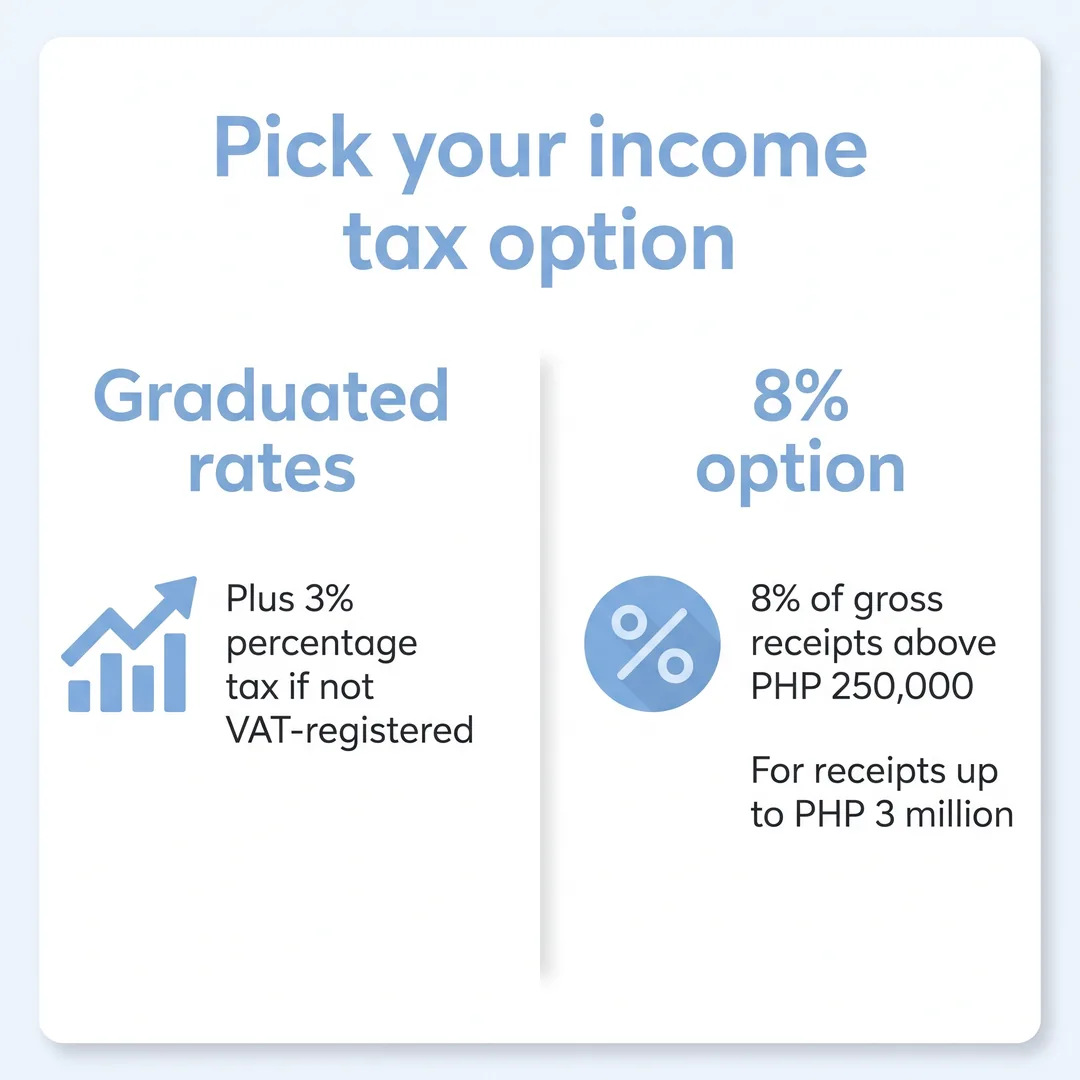
By default, a self-employed individual is taxed on net taxable income at the graduated rates. The BIR says all individuals start each year on graduated rates unless they choose the 8% option (BIR RMO 23-2018 digest).
You also pay a 3% percentage tax on gross quarterly receipts if you are not VAT-registered. The BIR confirmed that this rate returned to 3% on 1 July 2023 (BIR RMC 69-2023).
Option 2: 8% tax on gross receipts
The Tax Code lets purely self-employed individuals and professionals pay 8% on gross sales or receipts and other non-operating income above ₱250,000. This replaces the graduated rates and the percentage tax (RA 10963, Section 24(A)(2)(b)).
To qualify, your gross receipts and other non-operating income must not exceed the ₱3 million VAT threshold.
You choose the option when you register or in your first quarterly return of the year. The choice lasts for that year only and you must choose again each year (BIR RMO 23-2018 digest).
If you also have a job, you are a mixed income earner. The ₱250,000 reduction does not apply to you under the 8% option.
What happens above ₱3 million
Once gross receipts pass ₱3 million in a year, you move to graduated rates and become liable for VAT. Update your registration straight away.
Step 6: Sign up for SSS and PhilHealth
SSS for self-employed members
The SSS says a self-employed person has no employer other than themselves. Your contribution is based on the monthly earnings you declare, and you can pay monthly or quarterly with a payment reference number from My.SSS (SSS: Self-employed).
The Social Security rate is 15% of the Monthly Salary Credit, up to ₱35,000, and self-employed members pay it all themselves (SSS: Pay contributions).
The SSS says late payments by self-employed members are not allowed, so missed months stay as gaps.
PhilHealth
PhilHealth says direct contributors pay premiums of 5% of their monthly income, effective January 2025, with a minimum monthly premium of ₱500 (PhilHealth Advisory 2026-0042).
Check your PhilHealth membership type on its website and use your real income.
Step 7: Find your first clients
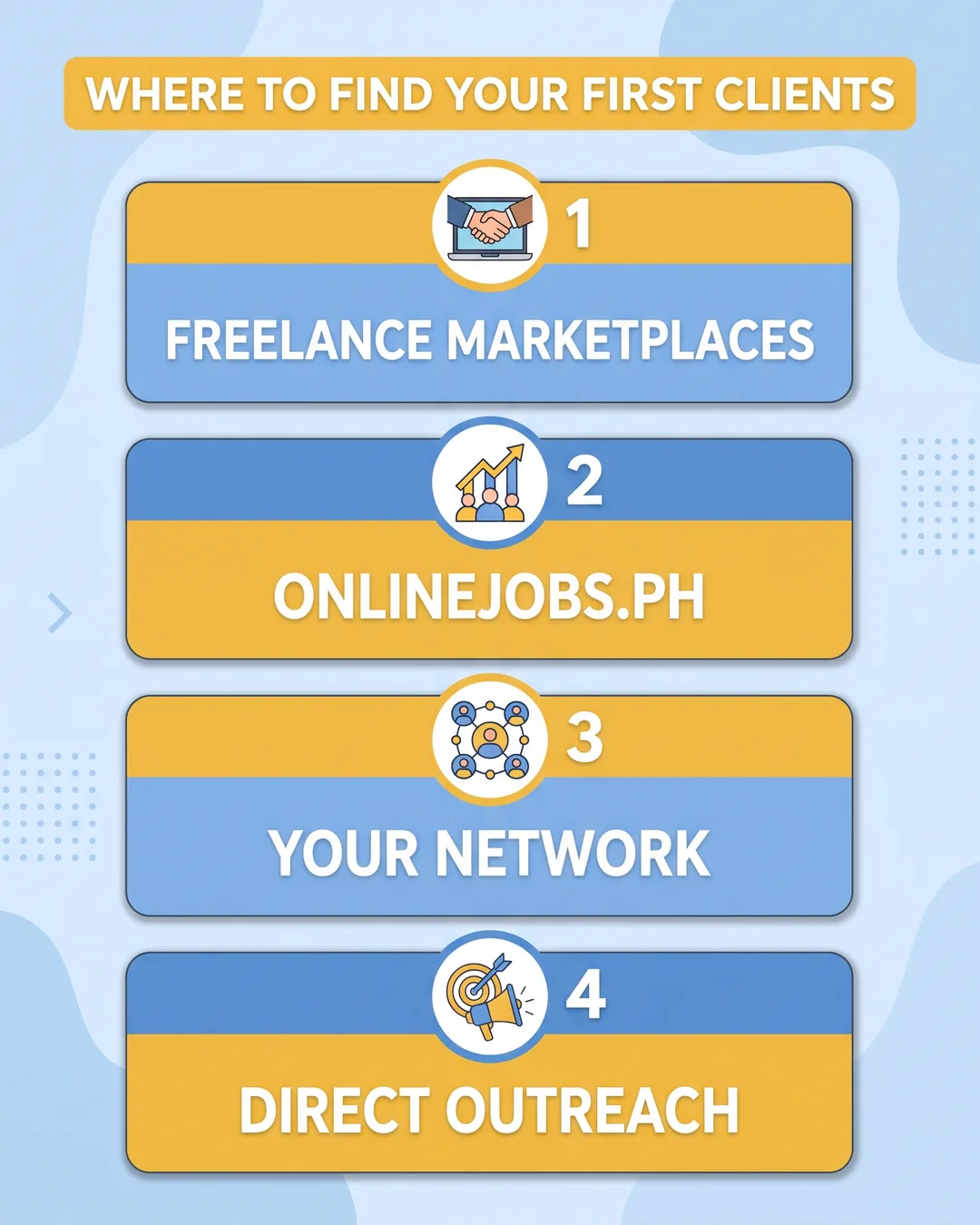
Freelance marketplaces
Upwork connects freelancers with clients worldwide. It says its freelancer service fee ranges from 0% to 15% per contract and is shown before you send a proposal (Upwork Help).
See how it compares in is Upwork worth it and our list of the best freelance websites.
OnlineJobs.ph
OnlineJobs.ph is a job board where employers hire Filipino workers directly. Read each job post carefully, ask for the work terms in writing and never pay to get a job.
Your network and direct outreach
Tell friends, former colleagues and local business owners what you offer. Join relevant Facebook and LinkedIn groups and answer questions to show your skills.
Send short messages to businesses with a specific idea on how you can help.
Step 8: Set your rates and agree terms
Work out your target income, then add tax, SSS, PhilHealth and unpaid time. Use our freelance hourly rate calculator and read how much should I charge as a freelancer.
Agree scope, price, payment dates and revisions in writing before you start. See our freelance contract guide.
Send a clear invoice every time. Here is how to invoice as a freelancer.
Tips for staying consistent
- Set weekly hours. Block time for client work and for finding new clients.
- Save for tax and contributions. Move a fixed share of each payment to a separate account.
- Keep every record. Save contracts, invoices and payment proofs.
- Avoid job scams. Be careful with any offer that asks for money or personal ID before work starts.
FAQ
How do I register as a freelancer in the Philippines?
Register with the BIR at your Revenue District Office using BIR Form 1901 as a self-employed individual or professional. Bring the documents your RDO asks for, and choose your income tax option.
How much does a freelancer make in the Philippines?
It depends on your skill, niche, experience and clients. No single figure fits everyone, so set your rate from your own costs and target income.
Do freelancers in the Philippines need to pay tax?
Yes. Self-employed individuals pay income tax, and they pay percentage tax or VAT unless they choose the 8% option. Your registration and income decide which applies.
Do I need to pay SSS and PhilHealth as a freelancer?
A self-employed person is covered by SSS and pays contributions based on declared earnings. PhilHealth premiums are based on monthly income.
Do I need a license to freelance?
Registering with the BIR is the main step. If your profession is regulated by the PRC, such as accounting or engineering, you also need that professional license. BIR Form 1901 has a separate taxpayer type for licensed professionals.
Conclusion
Freelancing in the Philippines starts with a clear skill, a small portfolio and your BIR registration. Choose your tax option, pay your SSS and PhilHealth, then build a steady flow of clients from several sources.