To become a freelancer on the side, pick one skill people already pay for, find your first client through people you know or a freelance platform, set a clear price, and track every payment from day one. You can do all of this while keeping your job.
Key takeaways
- Start with one skill. A narrow offer is easier to explain and easier to sell than “I can do anything”.
- Keep your job while you test. Take one or two small projects before you decide how much time to give freelancing.
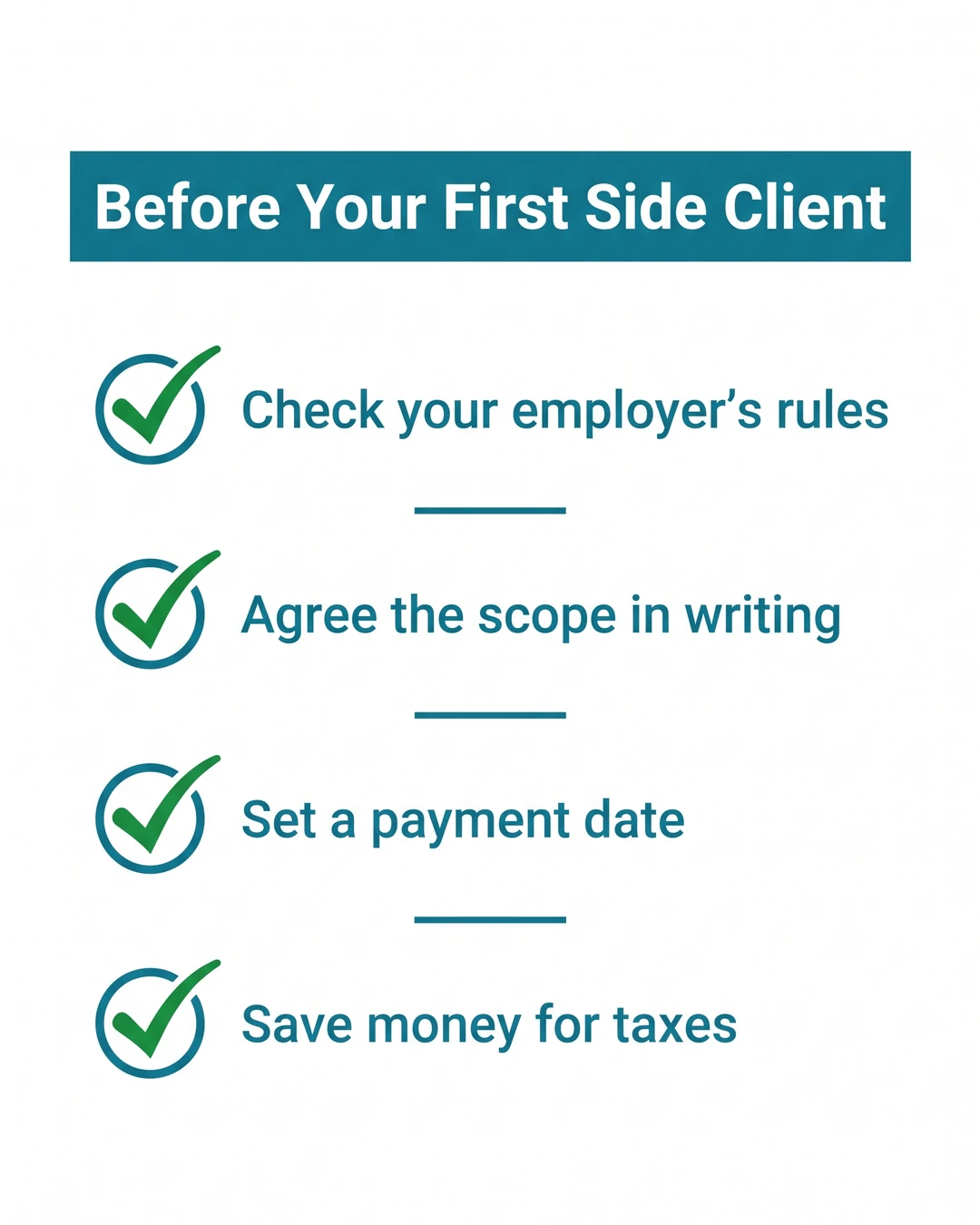
- Agree terms in writing. Scope, price and payment date should be clear before you start.
- Plan for taxes early. The IRS says you usually must pay self-employment tax if your net earnings are $400 or more.
- Check your employment contract. Some employers have rules on outside work, so read yours first.
What does it mean to freelance on the side?
Freelancing on the side means you sell your skills to clients in your spare time, while you keep a day job or study. You are not an employee of those clients.
The IRS says that if you are an independent contractor or in business for yourself, you are generally considered self-employed (IRS: Independent contractor (self-employed) or employee?). That affects how you are paid and how you pay tax.
If you are new to the idea, read our guide on what freelancing is first.
10 steps to start freelancing on the side
1. Choose one skill to sell
List what you already do well at work, at school or as a hobby. Then pick the one that other people or businesses are likely to pay for.
- Writing, editing or translation
- Design, video editing or social media graphics
- Web development, coding or no-code site building
- Bookkeeping, admin support or customer support
- Tutoring, coaching or training
A narrow offer works better at the start. “I edit YouTube videos for small creators” is clearer than “I do digital work”.
2. Check your employment rules
Read your employment contract and any company policy on outside work. Look for rules on conflicts of interest, working for competitors and using company time or equipment.
Never do client work on your employer’s laptop or during paid hours. If a rule is unclear, ask HR or get advice before you take clients.
3. Set a weekly time budget
Decide how many hours a week you can give, and block them in your calendar. A small, steady block is easier to keep than a big plan you drop in week two.
Tell clients your real turnaround times. Do not promise same-day work if you can only work evenings.
4. Build a small proof of work
Clients want proof that you can do the job. Make two or three samples that look like real client work, and put them on one simple page.
- A short description of the problem and what you did
- The result, if you can share one
- A clear way to contact you
Only show work you have permission to show. Never copy someone else’s samples.
5. Find your first client
Start with people who already know you. Tell friends, past colleagues and former classmates what you offer, and ask who might need it.
Then try a freelance platform. Our list of the best freelance websites compares the main options, and how to start freelancing with no experience covers the first pitch.
Platforms charge fees. For example, Upwork says its freelancer service fee ranges from 0% to 15% per contract and is shown before you send a proposal (Upwork Help).
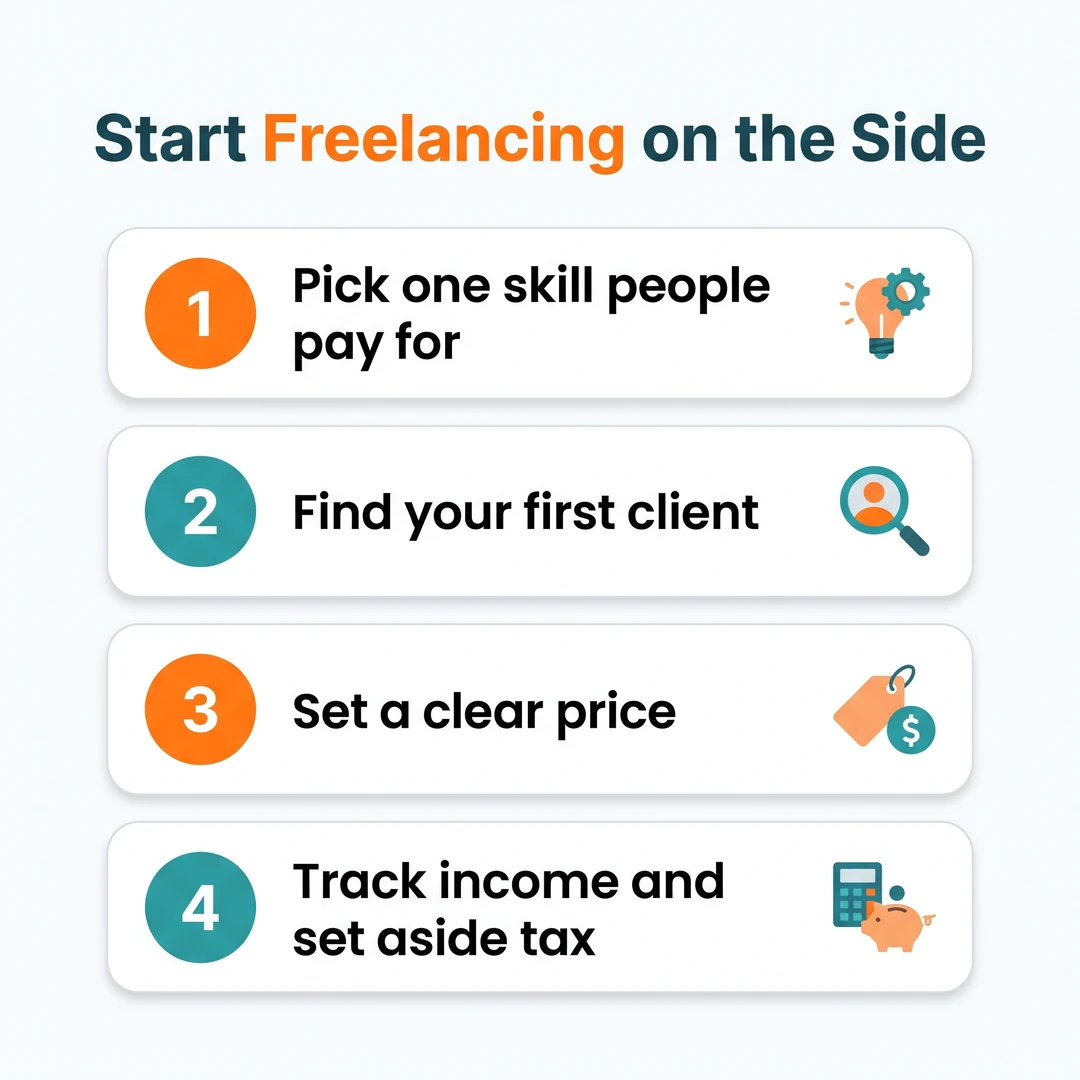
6. Set a clear price
Do not guess. Work out what you need to earn per hour after tax and costs, then price the project from your real time.
Use our freelance hourly rate calculator and read how much should I charge as a freelancer before you send your first quote.
Beginners often under-price. A low first price is fine if you keep it as a one-off, but say what the normal price is.
7. Agree the scope in writing
Before you start, write down what you will deliver, how many revisions are included, the price and the payment date.
Even a one-page agreement helps. Our freelance contract guide shows what to include.
8. Invoice and track every payment
Send an invoice for every job, and record every payment in one place. Our guide on how to invoice as a freelancer shows what to put on it.
The IRS says you may choose any recordkeeping system suited to your business that clearly shows your income and expenses (IRS: Recordkeeping). A simple spreadsheet is enough to start.
9. Set money aside for taxes
In the U.S., the IRS says you usually must pay self-employment tax if you had net earnings from self-employment of $400 or more (IRS Topic 554).
The IRS also says individuals, including sole proprietors, generally have to make estimated tax payments if they expect to owe tax of $1,000 or more when their return is filed (IRS: Estimated taxes).
Rules differ in other countries, so check with your local tax authority. Ask a tax professional if your situation is complex.
10. Review after 90 days
After three months, look at what you earned, how many hours it took and which clients were easy to work with. Then decide whether to raise prices, take more clients or stop.
Common mistakes when freelancing on the side
- Taking every project. Say no to work that does not fit your skill or your schedule.
- Starting without a written agreement. It is the most common cause of payment problems.
- Ignoring tax until the year ends. Move a share of each payment into a separate account.
- Promising too much. Be honest about how many hours you have.
- Mixing up work time. Keep client work away from your employer’s time and equipment.
When to go full time
There is no single number that tells you it is time to quit. Look at your own figures first.
- You have steady client demand for several months in a row.
- Your freelance income covers your costs, including tax and health insurance.
- You have savings that cover several months of expenses.
- You have a plan for finding new clients when a project ends.
If you want a deeper look at the next step, read how to become self-employed.
FAQ
Can I freelance while working a full-time job?
Often yes, but check your employment contract first. Look for rules on outside work, conflicts of interest and use of company time or equipment.
How much can I earn freelancing on the side?
It depends on your skill, the hours you can give and the prices you charge. Use the hourly rate calculator above to work out a target from your own costs.
Do I have to pay taxes on side income?
In the U.S., yes. The IRS says you usually must pay self-employment tax if your net earnings are $400 or more, and you may need to make estimated tax payments.
What is the best skill to start with?
The best skill is one you already have, that clients pay for, and that you can deliver in your available hours. Start there rather than learning something new from scratch.
How do I find my first client?
Tell people you know what you offer, then pitch on a freelance platform with a clear sample of your work.
Conclusion
Freelancing on the side lets you test the work before you give up a steady paycheck. Pick one skill, find a first client, agree terms in writing, and keep clean records and a tax reserve from the first payment.