
Freelancing as a doctor can mean telehealth visits, temporary shifts or non-clinical work, but licensing and privacy rules come first.
This guide explains the main routes, what U.S. physicians earn according to the Bureau of Labor Statistics, and what to check before you go independent.
Key takeaways
- Licensing decides where you can practice. A telehealth visit happens in the state where the patient is located, so check that state’s rules first.
- Pay data excludes self-employed doctors. BLS lists a May 2025 median of $275,930 for physicians and surgeons, but its wage data does not cover self-employed workers.
- Privacy rules apply. HHS says your telehealth platform should meet HIPAA requirements and you should get informed consent.
- You pay self-employment tax. The IRS rate is 15.3% (Social Security and Medicare) on net earnings of $400 or more.
- Demand is steady. BLS projects physician employment to grow 4% from 2025 to 2035.
What does freelancing as a doctor mean?
It means working for yourself or taking short contracts instead of one permanent job. You may still work with hospitals, clinics or telehealth companies.
Telehealth.HHS.gov explains that telehealth lets you care for a patient when you are not in the same location, through live video, audio-only calls or secure messaging.
It also describes “store and forward” care, where images or messages are shared at different times, and remote patient monitoring with devices such as blood pressure monitors and glucose meters.
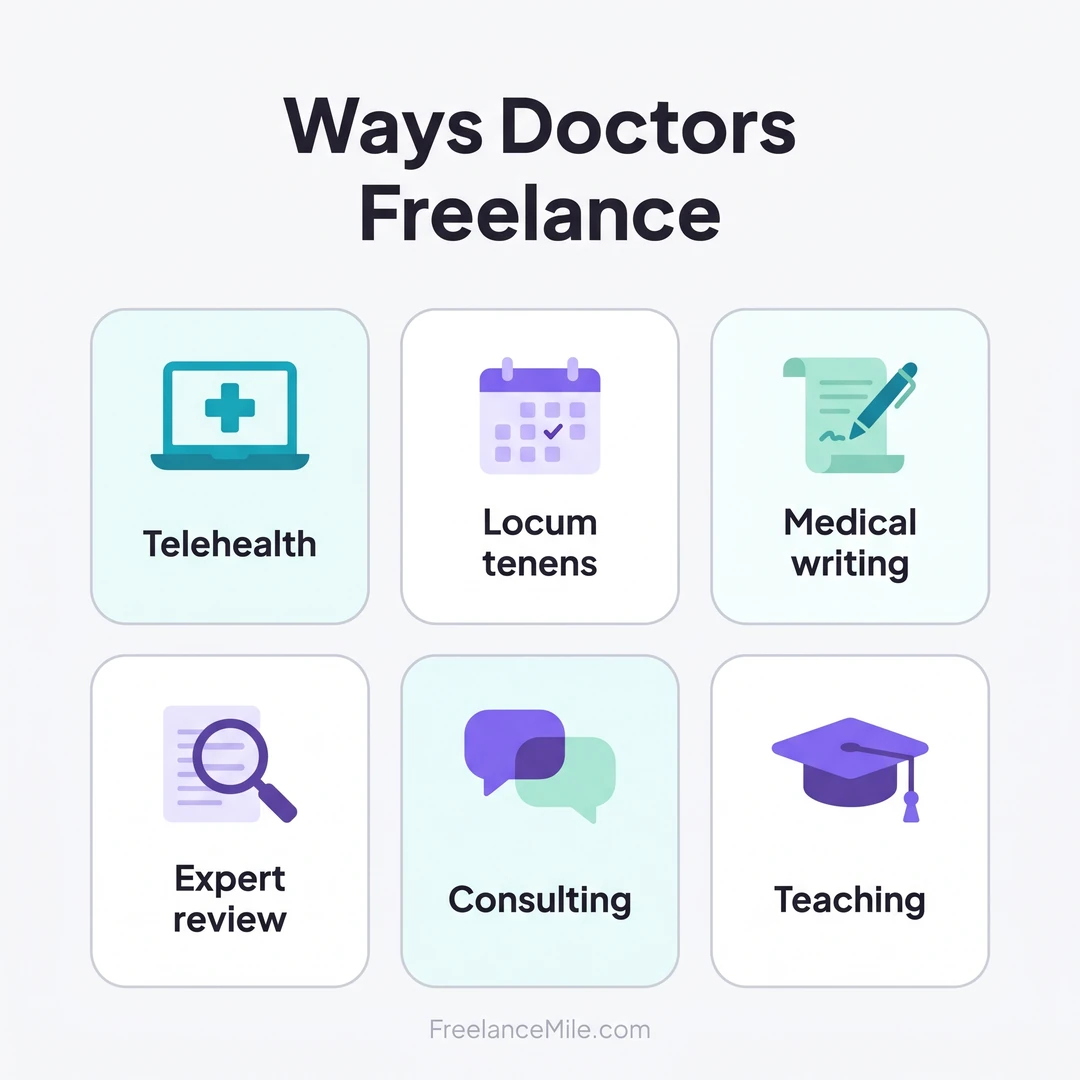
Ways doctors freelance
These are common routes. Which ones you can use depends on your specialty, licence and contracts.
1. Telehealth visits
You see patients by video, phone or secure message. HHS says to verify the patient’s location and obtain consent before each appointment (HHS).
2. Locum tenens shifts
Locum tenens means working temporary shifts or contracts to cover for another physician or a clinic. Rates, contracts and malpractice cover differ, so compare each offer in writing.
3. Medical writing and expert review
Some doctors write or review health content, or advise companies as consultants. BLS notes that physicians also work in nonclinical settings such as government agencies, nonprofit organizations and insurance companies.
If writing appeals to you, see our guide to the freelance health and wellness writer role.
4. Consulting and teaching
You can offer advice, second opinions on non-clinical questions, or training for other professionals. Keep these separate from patient care unless your licence and insurance cover them.
How much do doctors earn?
BLS lists a median annual wage of $275,930 for physicians and surgeons in May 2025, or $132.66 an hour.
The lowest 10 percent earned less than $76,560, and the highest 10 percent earned more than $488,320.
These numbers cover wage and salary workers only. BLS says its wage data does not include self-employed workers, so there is no official figure for freelance doctors here.
Your own income will depend on your specialty, hours, location, and how many billable sessions you complete.
Licensing and telehealth rules
BLS says all states require physicians and surgeons to be licensed, and requirements vary by state. Candidates must graduate from an accredited medical school and complete residency training (BLS).
For telehealth, HHS says an appointment occurs in the state where the patient is located at the time of the visit.
HHS lists several ways to work across state lines:
- Getting a full licence in that state.
- Checking temporary practice laws.
- Checking licensure reciprocity (some states allow it with a shared border).
- Joining a licensure compact, such as the Interstate Medical Licensure Compact (IMLC), which HHS says authorizes physicians to practice in multiple states.
- Applying for telehealth registration, where a state offers it.
HHS says typical telehealth registration terms include a current, valid and unrestricted licence in another state, proof of professional liability insurance, and no in-person office in that state.
Always confirm the rules with the state medical board, because they change.
Privacy, consent and technology
HHS advises providers to use private locations for telehealth and implement reasonable HIPAA safeguards for protected health information.
It also says the telehealth platform you use should meet HIPAA requirements, and you should get informed consent from patients before an appointment.
HHS suggests asking vendors questions such as:
- Is the product HIPAA compliant?
- Is a contract required?
- Does it integrate with my electronic health record?
- Will it be easy for my patients to use?
- What are the costs, and are they per visit or a single charge?
Taxes for self-employed doctors
The IRS says the self-employment tax rate is 15.3%, made up of 12.4% for Social Security and 2.9% for Medicare (IRS).
You generally owe it if your net earnings from self-employment were $400 or more. You calculate it on Schedule SE.
See our guides on freelance bookkeeping and freelance contracts for the business side. A tax professional can advise on your situation.
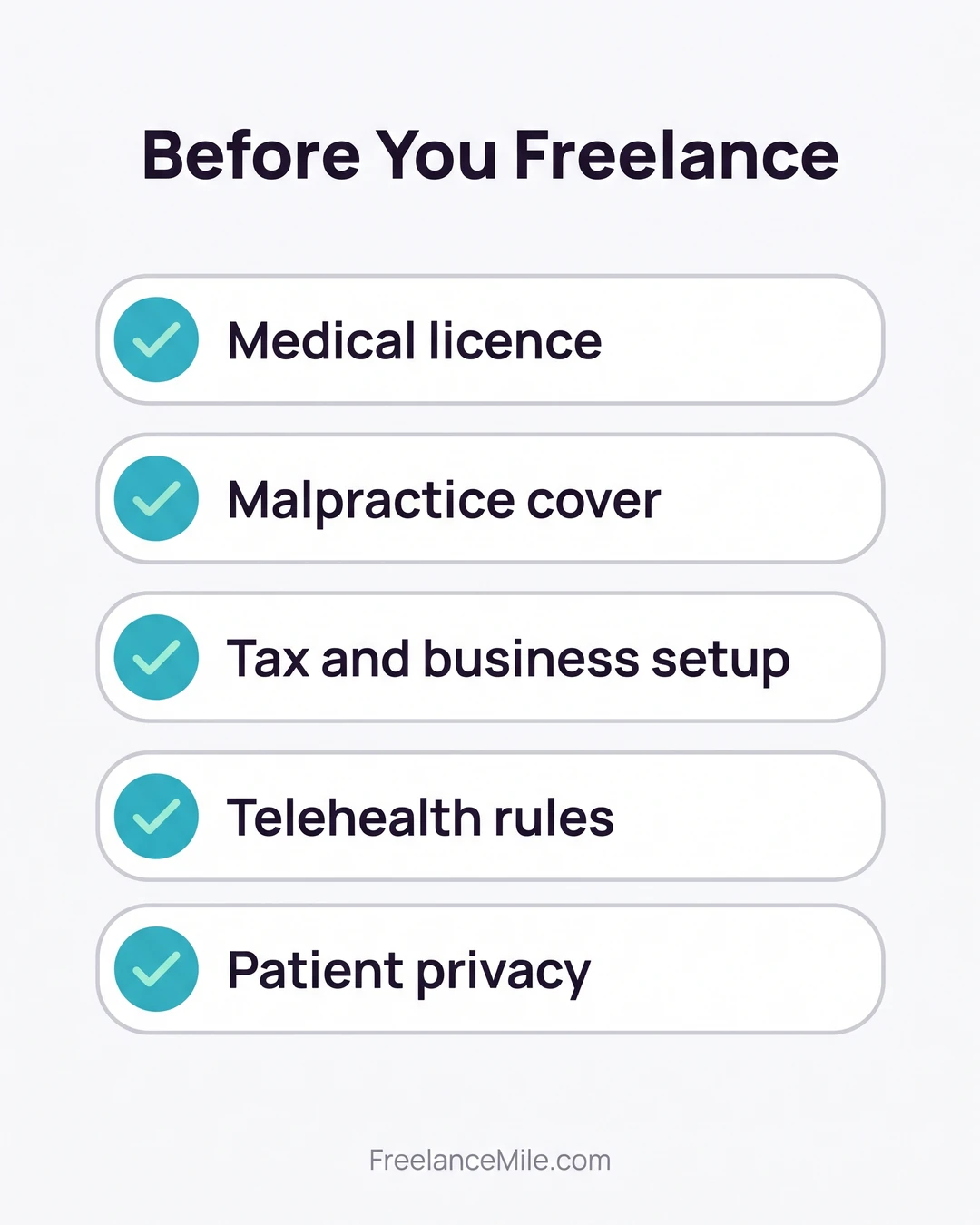
Before you start: a quick checklist
- Licence. Confirm you hold an active licence in every state where patients will be.
- Insurance. Ask whether your malpractice cover applies to telehealth and independent work.
- Business setup. Decide how you will invoice, track income and pay estimated taxes.
- Telehealth rules. Check each state’s licence, registration and consent rules.
- Privacy. Use a HIPAA-compliant platform and a private space.
FAQ
Can a doctor work as a freelancer?
Yes. Doctors can contract for telehealth, temporary shifts or non-clinical work, as long as licensing, insurance and employer rules are met.
Do I need a licence in every state I treat patients in?
HHS says a telehealth appointment occurs where the patient is located, and lists compacts, registration and temporary practice laws as options. Check the state board (HHS).
How much do freelance doctors make?
There is no official BLS figure for self-employed doctors. BLS reports a May 2025 median of $275,930 for physicians and surgeons who are wage and salary workers.
Do I pay self-employment tax?
Generally yes if your net self-employment earnings were $400 or more. The IRS rate is 15.3% (IRS).
Conclusion
Freelancing as a doctor can offer more control over your schedule, but it adds licensing, insurance, privacy and tax work. Start by confirming the rules in the states where your patients are.
For more career ideas, see best paying jobs in health care and side hustles for nurses.