
A freelance health and wellness writer creates articles, guides and marketing content about health, fitness, nutrition and medical topics for clients.
This guide covers 10 markets that hire health writers, the rules you must follow and how to start. Pay data comes from the Bureau of Labor Statistics.
Key takeaways
- Writing is a freelance-heavy field. BLS says 65% of writers and authors were self-employed in 2025.
- Pay benchmark: the May 2025 median for writers and authors was $76,910, and $90,390 for technical writers.
- Accuracy matters more here. Google says health content must be highly accurate and match expert consensus.
- Health claims need evidence. The FTC expects competent and reliable scientific evidence for product claims.
- Pick a niche. Fitness, nutrition, mental health and digital health each have different clients.
What does a health and wellness writer do?
You research a health topic, read the evidence, sometimes interview experts, and turn it into clear content for readers.
Work includes blog posts, patient guides, newsletters, website pages, email campaigns and educational material.
What health writers earn
There is no official figure for freelance health writers, so BLS employee pay is the best benchmark.
Scroll sideways to see the full table.
| Role (BLS) | Median pay, May 2025 | Outlook 2025-35 |
|---|---|---|
| Writers and authors | $76,910 a year | 0% (about 11,900 openings a year) |
| Technical writers | $90,390 a year | 1% (about 3,200 openings a year) |
BLS pay data does not include self-employed workers, so freelance income can be higher or lower (BLS).
10 markets for freelance health and wellness writers
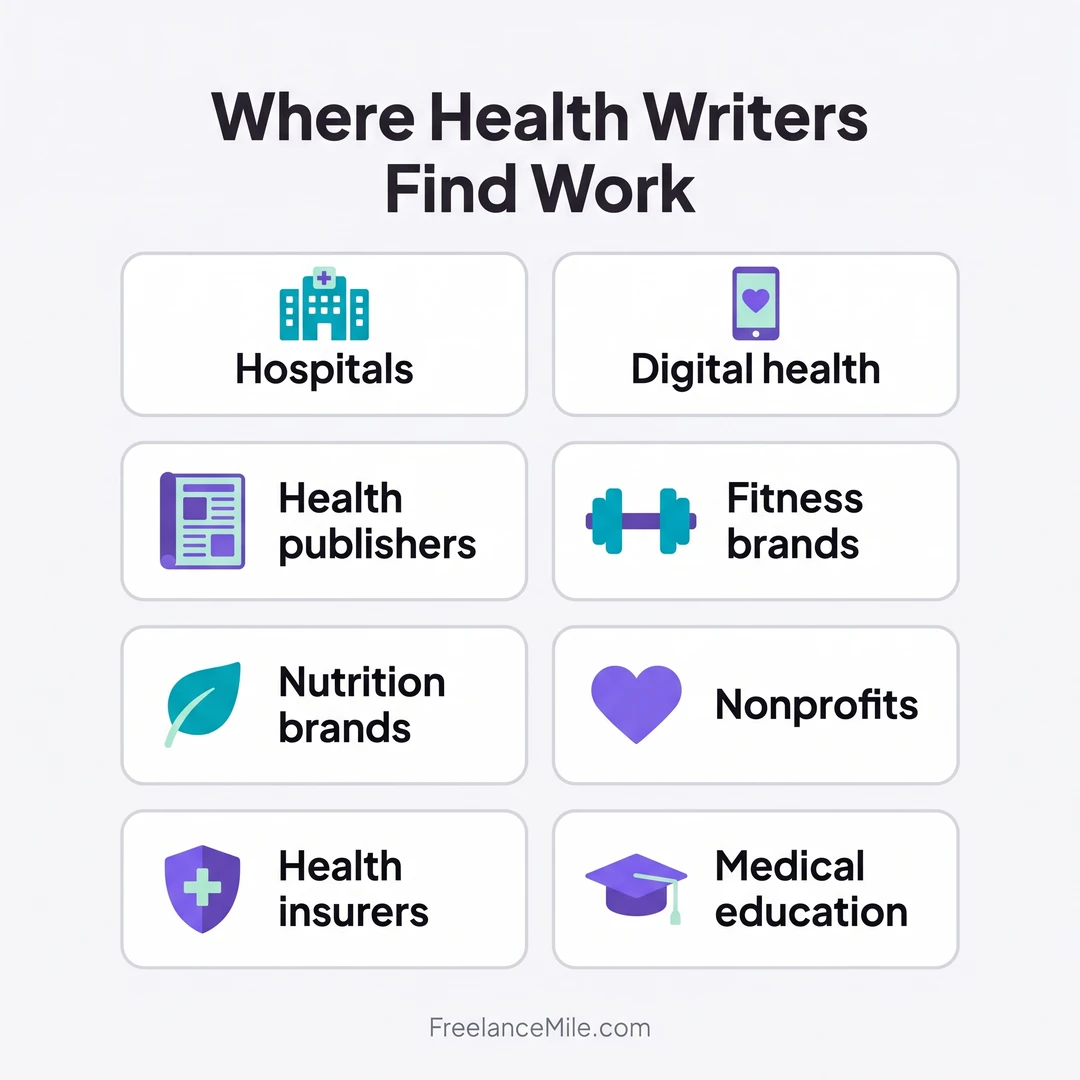
1. Hospitals and health systems
Hospitals need patient guides, service pages, newsletters and blog posts, usually reviewed by clinicians.
2. Digital health and telehealth companies
App and telehealth companies need onboarding content, help articles, blog posts and email sequences.
3. Consumer health publishers
Health websites and magazines buy explainers and features. Most have editorial standards and medical reviewers.
4. Fitness brands and gyms
Gyms, trainers and equipment brands need workout guides, class descriptions and newsletters.
5. Nutrition and supplement brands
These clients need product pages and blogs. Any health claim must meet the FTC evidence standard.
6. Health nonprofits
Nonprofits need plain-language fact sheets, campaign content, reports and grant support.
7. Health insurers
Insurers publish member guides, benefits explainers and wellness content that must be clear and accurate.
8. Medical communications agencies
Agencies that serve pharma and device companies hire writers for educational and promotional material.
9. Medical education providers
Course and training providers need writers for lessons, summaries and learning materials for health professionals.
10. Private practices
Therapists, dietitians, dentists and clinics need website pages, blogs and newsletters for their patients.
Rules every health writer must know
Use trusted sources
Start with primary research on PubMed and plain-language health information from MedlinePlus.
Write for accuracy and trust
Google says it gives more weight to strong E-E-A-T on topics that could affect people’s health, called YMYL topics.
For those topics, Google says content must be highly accurate and consistent with established expert consensus.
Do not overstate health claims
The FTC Health Products Compliance Guidance (December 2022) says health claims need competent and reliable scientific evidence.
As a general rule, that means randomized, controlled human clinical trials. Ask clients for their evidence before you write a claim.
Disclose paid relationships
If you endorse products or use affiliate links, follow the FTC Endorsement Guides (16 CFR Part 255).
How to start as a freelance health writer
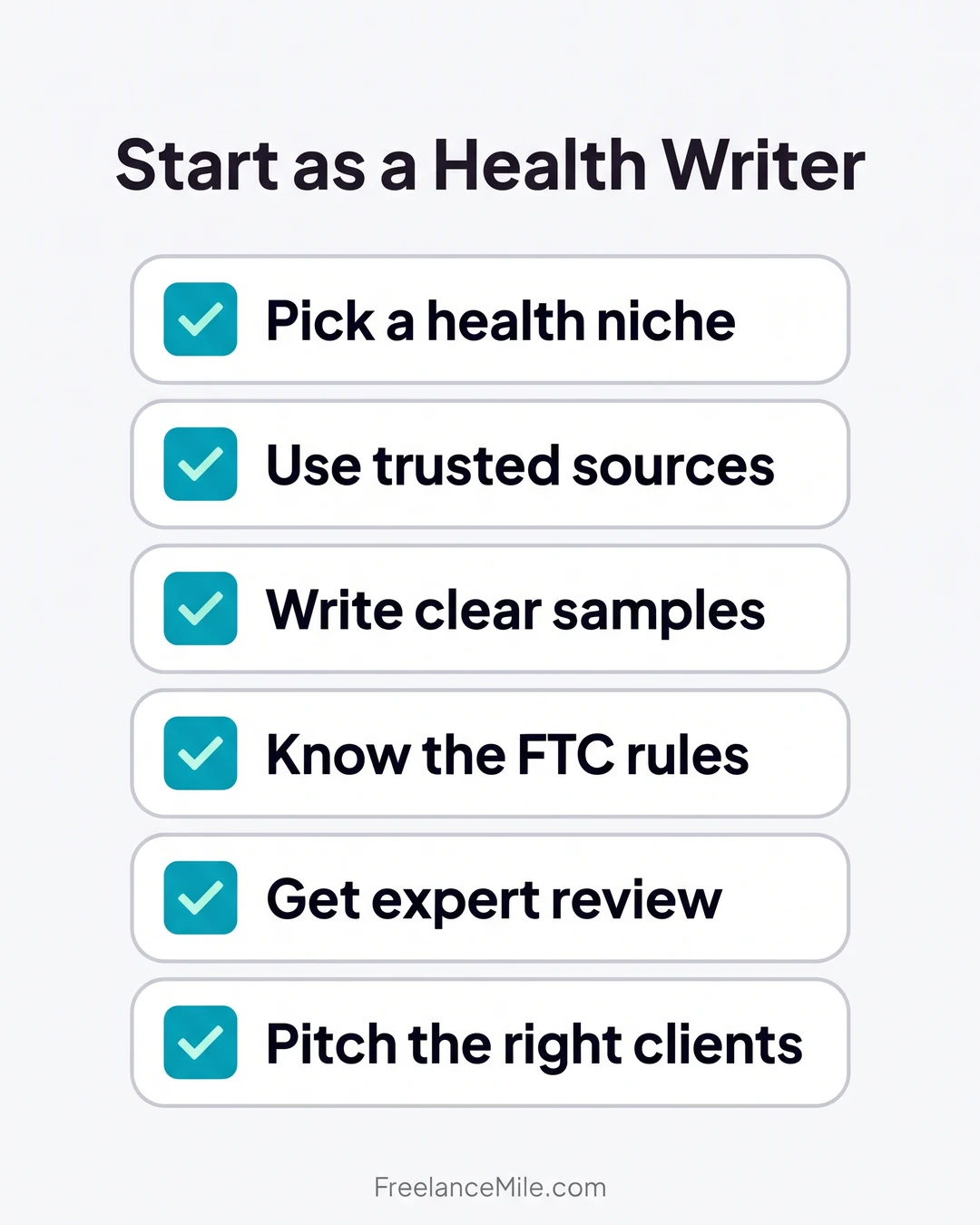
- Pick a niche you know well, such as fitness, nutrition, mental health or digital health.
- Write three samples on that niche, each built on trusted, linked sources.
- Learn the rules above, so clients trust you with sensitive topics.
- Offer expert review. Many clients want a clinician to check health content before it goes live.
- Pitch the right clients from the 10 markets, and tailor each pitch to their readers.
- Join a community such as the Association of Health Care Journalists to learn and network.
FAQ
Do I need a medical degree to be a health writer?
No. BLS says a degree in English, communications or journalism is generally required for full-time writer jobs (BLS). A health background helps.
How much do freelance health writers make?
There is no official freelance figure. As a benchmark, BLS lists a May 2025 median of $76,910 for writers and authors.
Where can I find health writing jobs?
Start with the 10 markets above, especially hospitals, digital health companies and medical communications agencies.
Can I use AI to write health content?
Only with care. Check every fact against a trusted source, and never publish health claims you cannot support.
Conclusion
Health and wellness writing rewards writers who pick a niche, use trusted sources and follow the FTC and Google rules.
For more, see freelance writing niches, freelance copywriter and how to start writing.