
All 20 of the highest paying jobs in the US are health care jobs, and the best paying jobs in health care pay a median of $559,030 a year for pediatric surgeons. That is the 2025 median pay from the U.S. Bureau of Labor Statistics (BLS).
Below are 15 top health care careers with BLS median pay, the training each one needs, and the job outlook to 2035. You will also see which ones don’t need medical school (BLS highest paying occupations).
Key takeaways
- Doctors and surgeons earn the most. The top physician and surgeon specialties here have median pay from $281,870 to $559,030.
- Nurse anesthetists lead the non-doctor jobs. They earn a median $236,590 with a master’s degree.
- Dentists and specialists pay well too. Dentists earn a median $176,110 and orthodontists $289,140.
- Faster routes still pay six figures. Physician assistants earn a median $135,880 and nurse practitioners $132,300.
- Training time is the real price. Doctors need 3 to 9 years of residency on top of medical school.
Best paying jobs in health care at a glance
All pay figures are median annual wages for May 2025 from the BLS Occupational Outlook Handbook. The median means half of workers earn more and half earn less (BLS healthcare occupations).
Scroll sideways to see the full table.
| Job | Median pay, May 2025 | Typical entry route | Job growth, 2025 to 2035 |
|---|---|---|---|
| Pediatric surgeons | $559,030 | Medical degree + residency | 2% |
| Cardiologists | $496,010 | Medical degree + residency | 5% |
| Radiologists | $420,860 | Medical degree + residency | 3% |
| Anesthesiologists | $391,490 | Medical degree + residency | 4% |
| Orthopedic surgeons (except pediatric) | $358,550 | Medical degree + residency | 4% |
| Oral and maxillofacial surgeons | $352,220 | Dental degree + residency | 6% |
| Orthodontists | $289,140 | Dental degree + residency | 6% |
| Psychiatrists | $281,870 | Medical degree + residency | 7% |
| Nurse anesthetists | $236,590 | Master’s degree | 10% |
| Dentists (all) | $176,110 | DDS or DMD degree | 6% |
| Pharmacists | $140,910 | Pharm.D. degree | 5% |
| Optometrists | $136,570 | O.D. degree | 10% |
| Physician assistants | $135,880 | Master’s degree | 21% |
| Nurse practitioners | $132,300 | Master’s degree | 41% |
| Medical and health services managers | $123,860 | Bachelor’s degree | 24% |
For comparison, the median for all US occupations was $50,980 in May 2025, per BLS.
The 15 best paying jobs in health care
1. Pediatric surgeons
Pediatric surgeons top the BLS list at a median $559,030 a year. They treat disorders and diseases in fetuses, infants, children and teens (BLS).
This is also a very small field. BLS counts about 1,300 pediatric surgeons, and expects 2 percent growth by 2035.
2. Cardiologists
Cardiologists diagnose and treat diseases of the heart and blood vessels. Their median pay is $496,010 a year (BLS).
About 18,500 cardiologists work in the US. BLS projects 5 percent growth from 2025 to 2035.
3. Radiologists
Radiologists read x rays, ultrasounds and other images to diagnose injuries and disease. They earn a median $420,860 (BLS).
BLS counts about 28,700 radiologists and projects 3 percent growth.
4. Anesthesiologists
Anesthesiologists manage pain relief and monitor patients during surgery. Their median pay is $391,490 a year (BLS).
There are about 41,500 anesthesiologists in the US. BLS projects 4 percent growth by 2035.
5. Orthopedic surgeons
Orthopedic surgeons treat bones, muscles, ligaments and tendons. BLS lists a median of $358,550 for orthopedic surgeons except pediatric (BLS).
About 15,500 people work in this job, and BLS expects 4 percent growth.
6. Oral and maxillofacial surgeons
These dental specialists operate on the mouth, jaws, teeth, gums, neck and head. They earn a median $352,220 (BLS).
BLS says residency for this specialty typically takes 4 to 6 years. About 5,600 people work in the job, with 6 percent projected growth.
7. Orthodontists
Orthodontists straighten teeth with braces and other appliances. Their median pay is $289,140 a year (BLS).
BLS says dental specialties usually need a 2 to 4 year residency after dental school. About 7,100 orthodontists work in the US.
8. Psychiatrists
Psychiatrists are the primary mental health physicians. They earn a median $281,870 a year (BLS).
BLS projects 7 percent growth for psychiatrists from 2025 to 2035, tied with dermatologists for the fastest among physician specialties. BLS points to growing demand for psychiatric care and better access to mental health services.
9. Nurse anesthetists
Nurse anesthetists (CRNAs) give anesthesia and care before, during and after procedures. They earn a median $236,590, the highest of the three advanced practice nurse roles (BLS).
They need a master’s degree, an RN license and at least 1 year of critical care experience as an RN before they can enter a nurse anesthetist program. About 54,500 nurse anesthetists work in the US.
10. Dentists
Dentists diagnose and treat problems with teeth, gums and the mouth. The median for all dentists is $176,110 a year, and general dentists earn $170,950 (BLS).
BLS says about 12 percent of dentists are self-employed. Projected growth is 6 percent.
11. Pharmacists
Pharmacists dispense prescriptions and advise patients and doctors on medicines. They earn a median $140,910 a year (BLS).
The job needs a Doctor of Pharmacy degree and a state license. Pharmacists working in hospitals earned a median $157,290, and those at pharmacies and drug retailers $132,940.
12. Optometrists
Optometrists examine eyes, prescribe corrective lenses and manage eye disease. Their median pay is $136,570 a year (BLS).
They need a 4-year Doctor of Optometry degree. BLS projects 10 percent growth, and says part-time work is common.
13. Physician assistants
Physician assistants examine, diagnose and treat patients under the supervision of a physician. They earn a median $135,880 a year (BLS).
Most need a master’s degree. Programs usually take at least 2 years after a bachelor’s degree. BLS projects 21 percent job growth, which is much faster than average.
14. Nurse practitioners
Nurse practitioners provide primary and specialty care, and in most states can prescribe medication and diagnose health problems. Their median pay is $132,300 (BLS).
This is the fastest growing job on the list. BLS projects 41 percent growth for nurse practitioners from 2025 to 2035, and about 336,300 people hold the job now.
15. Medical and health services managers
These managers plan and direct the business side of health care, from single departments to whole facilities. Their median pay is $123,860 a year (BLS).
This is the one job here that needs only a bachelor’s degree. BLS says employers also want work experience in an administrative or clinical role, and expects 24 percent growth.
Health care career paths: how long does each take?
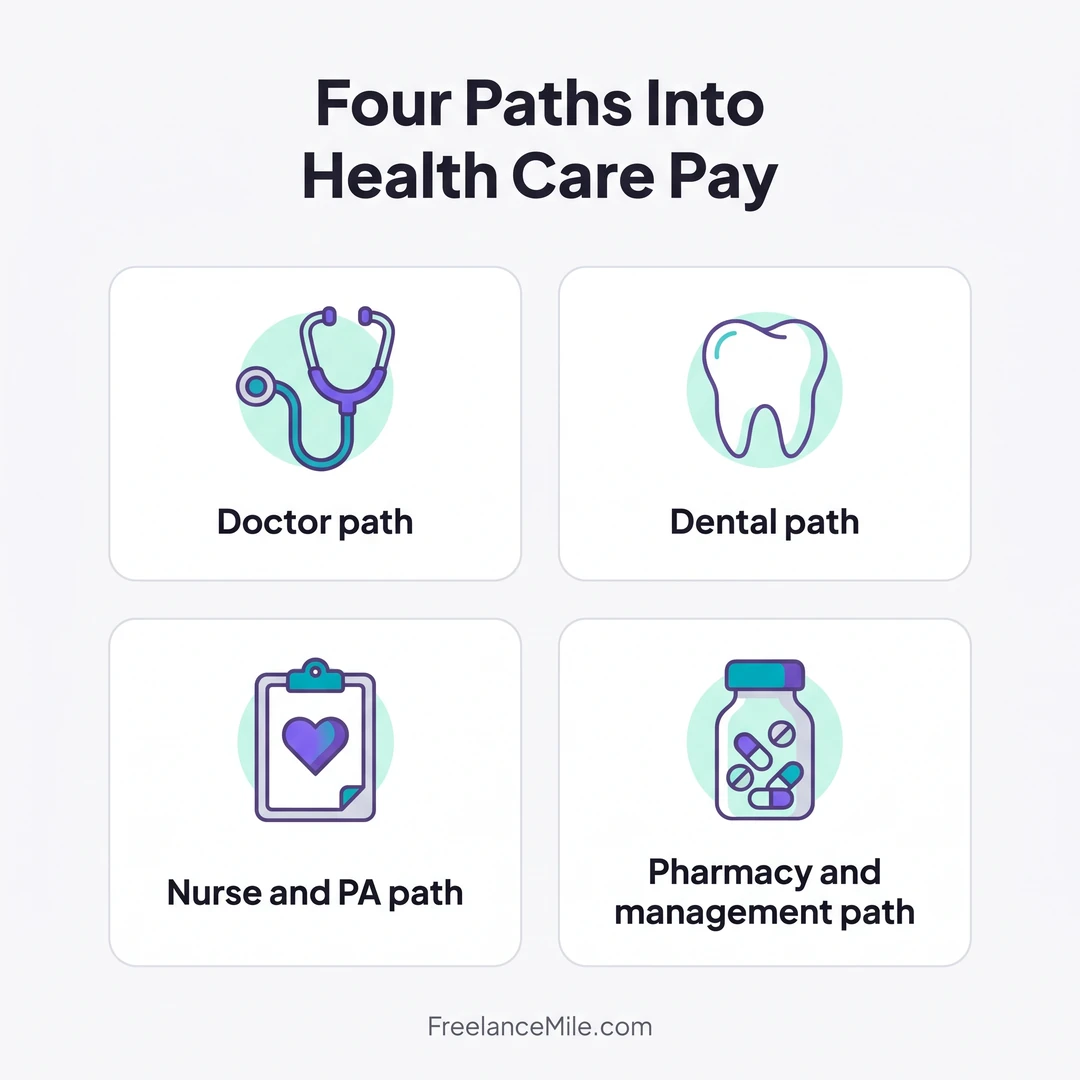
The jobs above fall into four paths. The pay goes up with the length of training, but not every high-paying job needs a decade of school.
Scroll sideways to see the full table.
| Path | Typical training | Examples |
|---|---|---|
| Doctor path | Bachelor’s degree, 4 years of medical school, then 3 to 9 years of residency | Cardiologists, radiologists, psychiatrists |
| Dental path | Dental degree, then a 2 to 4 year residency for most specialties | Orthodontists, oral surgeons |
| Nurse and PA path | Master’s degree (PAs: usually at least 2 years after a bachelor’s) | Nurse practitioners, nurse anesthetists, PAs |
| Pharmacy, vision and management | Pharm.D., O.D. (4 years) or bachelor’s degree | Pharmacists, optometrists, health managers |
The doctor path timing comes from BLS: a bachelor’s degree, then 4 years of medical school, then 3 to 9 years in residency depending on specialty. A fellowship adds 1 to 3 years.
Mid-range health care jobs without medical school
Not every good health care job needs a doctorate. These roles typically need an associate or bachelor’s degree and pay well above the $50,980 median for all workers (BLS, May 2025).
Scroll sideways to see the full table.
| Job | Median pay, May 2025 | Typical entry route | Job growth, 2025 to 2035 |
|---|---|---|---|
| Registered nurses | $97,550 | Bachelor’s degree (associate’s degree or diploma also possible) | 6% |
| Dental hygienists | $98,100 | Associate’s degree | 8% |
| Diagnostic medical sonographers | $96,590 | Associate’s degree or certificate | 14% |
| MRI technologists | $95,480 | Associate’s degree plus several years of related experience | 5% (radiologic and MRI technologists combined) |
| Respiratory therapists | $82,280 | Associate’s degree | 9% |
| Radiologic technologists and technicians | $80,110 | Associate’s degree | 5% (radiologic and MRI technologists combined) |
Most of these jobs need a state licence or certification, so check your state board before you pick a program.
Dental hygienist programs usually take about 3 years, according to BLS. Nearly all hygienists work in dentists’ offices, and many work part time.
How pay in health care compares
BLS puts the median pay for healthcare practitioners and technical jobs at $86,530 in May 2025, such as dental hygienists, physicians and registered nurses (BLS).
Healthcare support jobs, such as home health aides, had a median of $38,340. That is below the $50,980 median for all jobs.
Registered nurses earn a median $97,550, physical therapists $102,760 and occupational therapists $100,330 (BLS). They sit just under the top jobs on this list.
How to choose a high-paying health care career
Pay is only one part of the choice. Use the checklist below before you commit to years of training.

- Training time and cost. A master’s route takes years less than a medical route, but still needs a license and a certification exam.
- Licensing. Every state requires licenses for doctors, dentists, pharmacists, optometrists and physician assistants. Check your state board first.
- Job outlook. Nurse practitioners (41 percent) and health managers (24 percent) are growing the fastest on this list.
- Work hours. BLS notes that physicians and surgeons often work long shifts, overnight hours or on call.
Why do health care jobs pay so well?
BLS ties demand to an aging population and more chronic illness, such as diabetes, cancer and heart disease (BLS).
Overall employment in healthcare occupations is projected to grow much faster than average from 2025 to 2035, with about 1.9 million openings each year, according to BLS.
Can you freelance or earn extra in health care?
Most jobs on this list are employee or practice roles. BLS says about 12 percent of dentists are self-employed, for example.
If you want side income around a health career, see our guides on side hustles for nurses and medical courier work as an independent contractor.
Not ready for years of study? Our list of high paying jobs with no experience and entry-level jobs with no experience are good places to start.
FAQ
What is the highest paying job in health care?
Pediatric surgeons, with a median of $559,030 a year in May 2025, followed by cardiologists at $496,010 and radiologists at $420,860, according to BLS.
What is the highest paying health care job without going to medical school?
Nurse anesthetists, at a median $236,590. They need a master’s degree and a year of critical care experience as an RN. Dentists and orthodontists also earn more than $175,000 but need dental school.
Which health care jobs pay over $100,000 with a master’s degree?
Nurse practitioners ($132,300), physician assistants ($135,880) and nurse anesthetists ($236,590) are three master’s-level jobs with median pay above $100,000, per BLS.
How much does the average health care worker make?
BLS reports a median of $86,530 for healthcare practitioners and technical jobs and $38,340 for healthcare support jobs, both for May 2025.
Which health care job is growing the fastest?
Nurse practitioners, at a projected 41 percent growth from 2025 to 2035, then medical and health services managers at 24 percent and physician assistants at 21 percent.