

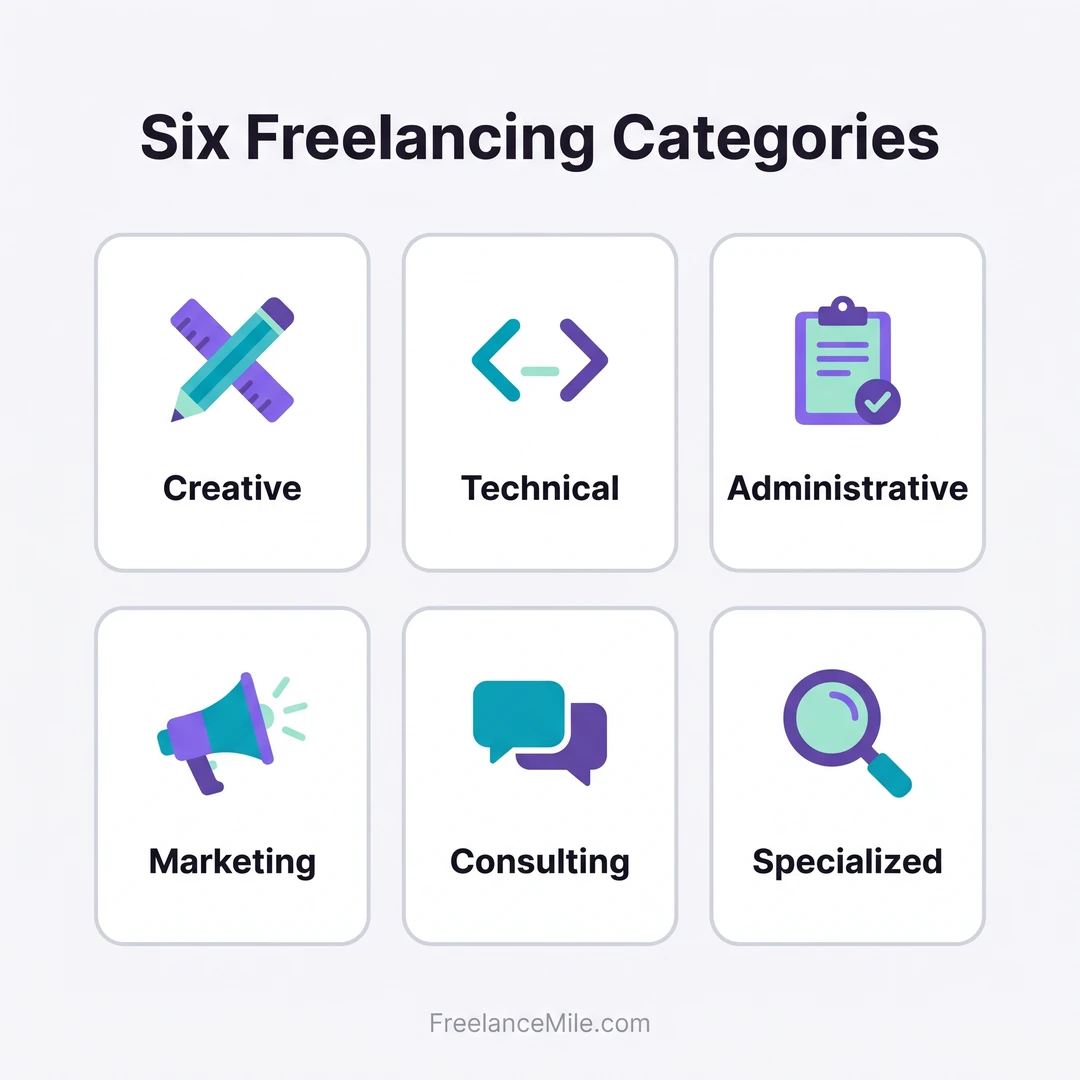
Freelancing has six broad categories: creative, technical, administrative, marketing, consulting and specialized work. Pick the one that matches a skill clients already pay for.
This 2026 guide explains each category with examples and official US pay data, so you can choose a starting point.
Key takeaways
- Six main categories cover most freelance work: creative, technical, administrative, marketing, consulting and specialized.
- Official US medians differ a lot. For May 2025 the BLS lists photographers at $44,660 a year and web developers at $92,650 (BLS).
- Those figures cover employed and self-employed workers together, so treat them as a guide, not as a freelance rate.
- Self-employment tax is 15.3% in the US, and you generally file if net earnings are $400 or more (IRS).
- Start with one category and one clear offer before you add more services.

The six main categories of freelancing
A freelancer is self-employed and sells a service to more than one client. The categories below are a practical way to group those services.
Real jobs often cross categories. A designer who builds websites sits between creative and technical work. Use the list to find a starting point, not a box.
Creative freelancing
Creative work turns ideas into visuals or words. Clients usually judge it by samples, so a portfolio matters more than a certificate.
Graphic design
Designers make logos, social graphics, brochures and layouts. The BLS says graphic designers usually need a bachelor’s degree for hired positions, but candidates should have a portfolio that shows creativity and originality.
See how to freelance as a graphic designer for the next steps.
Web design
Web designers plan how a site looks and works. Official data groups web developers and digital designers together, and education ranges from a high school diploma to a bachelor’s degree (BLS).
Our guide to freelance web design covers clients and pricing.
Photography
Photographers produce and preserve images of people, products and places. The BLS says many photographers are self-employed, and a portfolio is essential for many artists, including photographers.
If you want a lighter start, read our photography side hustle ideas.
Content writing and illustration
Writers produce blogs, articles, ads and scripts. The BLS says many writers and authors are self-employed, and that blogging and other writing that builds skill is useful practice.
Illustrators explain ideas through a single image. Like designers, they win work with a small set of strong samples.
Technical freelancing
Technical work builds or fixes digital things. Clients care about whether it works, so tests and finished projects are your proof.
Programming, web and app development
Developers write code and build sites and apps. The BLS lists a May 2025 median of $92,650 for web developers and $104,000 for web and digital interface designers.
IT support and data analysis
IT support freelancers fix technical problems for small businesses. Data analysts turn raw numbers into answers a client can act on.
Both can start with small, clearly scoped jobs, such as a one-time setup or a single report.
Technical writing
Technical writers explain complex products in plain language. Manuals, help articles and software guides are common examples.
Administrative freelancing
Administrative freelancers keep a client’s day-to-day work organized. Reliability and communication count more than flashy samples.
Virtual assistance and data entry
Virtual assistants handle email, calendars, bookings and simple research. Data entry means accurate typing and clean spreadsheets.
Customer service and project management
Remote customer support answers client questions on a schedule. Project managers keep tasks and deadlines moving for a small team.
Transcription
Transcriptionists turn audio into written text. Accuracy and turnaround time are what clients look at first.
Marketing freelancing
Marketing freelancers help a business get found and get replies. Show results you can prove, and describe them honestly.
Digital marketing and SEO
These freelancers work on visibility, such as search optimization and paid campaigns. Clients value clear reports over technical jargon.
Social media and content marketing
Social media managers plan and publish posts. Content marketers plan articles, newsletters and videos that support a business goal.
Email marketing
Email freelancers write and schedule campaigns and keep lists clean. Good subject lines and simple tracking are the basics.
Consulting freelancing
Consultants sell advice based on experience. Most start with a past job in the same field, so your work history is the main proof.
Business, HR, financial and marketing consulting
Business consultants review how a company runs. HR consultants advise on hiring and staff policy. Marketing consultants shape plans to reach customers.
Financial advice can be regulated in some places. Check the rules where you and your client live before you offer it.
Legal consulting
Legal work is licensed. The BLS says lawyers typically need a law degree and a state licence, which usually requires passing a bar examination.
Without a licence, stay with general business support and never give legal advice as if you were a lawyer.
Specialized freelancing
Specialized freelancers combine a skill with deep knowledge of one subject. That focus often makes it easier to explain why a client should hire you.
Legal and medical writing
These writers handle sensitive subjects, so accuracy and sourcing matter most. Clients usually expect proof of subject knowledge, which is why this work is a common fit for pharmacists who write on the side.
Translation
The BLS says interpreters and translators typically need at least a bachelor’s degree, and must be proficient in English and at least one other language. The May 2025 median pay was $60,170 a year.
Video editing
Video editors cut footage for creators and brands. See our guide to video editing rates for how editors price their work.
Official pay data by category
The table uses the latest US Bureau of Labor Statistics figures. They are occupation-wide medians, so they mix employed and self-employed workers.
Scroll sideways to see the full table.
| Occupation | Category | May 2025 median pay |
|---|---|---|
| Graphic designers | Creative | $62,960 a year |
| Writers and authors | Creative | $76,910 a year |
| Photographers | Creative | $44,660 a year |
| Web developers | Technical | $92,650 a year |
| Web and digital interface designers | Creative / technical | $104,000 a year |
| Interpreters and translators | Specialized | $60,170 a year |
These are not freelance rates. Your rate depends on your skill, your client and your costs. See how much to charge.
How to choose your category
Start with what you can already do, then check whether anyone pays for it. A skill with no buyers is a hobby, not a service.
Pick one category and one specific offer, such as “logo design for small cafes.” A narrow offer is easier to explain and easier to sell.
Try a small paid or practice project, then build a few samples. If you have no experience yet, read how to start freelancing with no experience.
Use a written contract from the first job, and look at the best freelance websites to find early clients.

Taxes and status
In the US, an independent contractor is generally self-employed, and the earnings are subject to self-employment tax (IRS).
The rate is 15.3%, and you generally file if net earnings are $400 or more (IRS). Rules differ in other countries, so check your local tax office.
Frequently asked questions
Which freelancing category is best for beginners?
Categories with low start-up cost, such as writing, design or virtual assistance, are common starting points. The best one is the skill you can already deliver.
Can I work in more than one category?
Yes, but start with one. Once you have steady clients, you can add a related service.
Do I need a degree to freelance?
Not for most categories. Licensed fields such as law are the exception. See our guide on whether you need a degree for freelancing.