
Disclosure: Fiverr is a FreelanceMile partner, and that partnership affects where it appears in this guide. Some links are affiliate links, so I may earn a commission at no extra cost to you. The pros, cons and fees for every platform, including Fiverr, are my honest take.
The best freelance translation websites for beginners are marketplaces where you can build a profile, take small jobs and collect reviews, plus translator-specific platforms.
This guide compares seven places to find work, with fees and requirements checked on each platform and U.S. pay and outlook data from the Bureau of Labor Statistics.
Key takeaways
- Start with a mix. Use one general marketplace for first reviews and one translator-focused platform for steadier work.
- Fees differ. Fiverr freelancers receive 80% of a cleared order, Upwork charges 0% to 15% per contract and Freelancer.com charges 10% or $5 on fixed-price projects.
- Some platforms test you first. Gengo asks new translators to pass a two-part test before they can start.
- Pay is moderate and outlook is slow. BLS lists a May 2025 median wage of $60,170 for interpreters and translators and projects 2% growth from 2025 to 2035.
- Certification is optional. BLS says general certification is not typically required, but optional tests can show proficiency.
What to know before you start freelance translation
BLS says translators convert written materials from one language into another, and must be proficient in English and at least one other language (BLS).
It also says the target language is usually the translator’s native language, and that most translators use computer-assisted translation (CAT) tools with translation memory.
Machine translation is common too. BLS says translators review machine output in a process called post-editing, and that AI makes the work more efficient but cannot yet match human translators in most cases.
Scroll sideways to see the full table.
| BLS fact (interpreters and translators) | Figure |
|---|---|
| Median annual wage, May 2025 | $60,170 |
| Median hourly wage, May 2025 | $28.93 |
| Number of jobs, 2025 | 73,900 |
| Projected growth, 2025 to 2035 | 2% |
| Self-employed share | 28% |
| Typical entry-level education | Bachelor’s degree |
Source: BLS Occupational Outlook Handbook. BLS wage data excludes self-employed workers, so freelance earnings will differ.
Best freelance translation websites for beginners
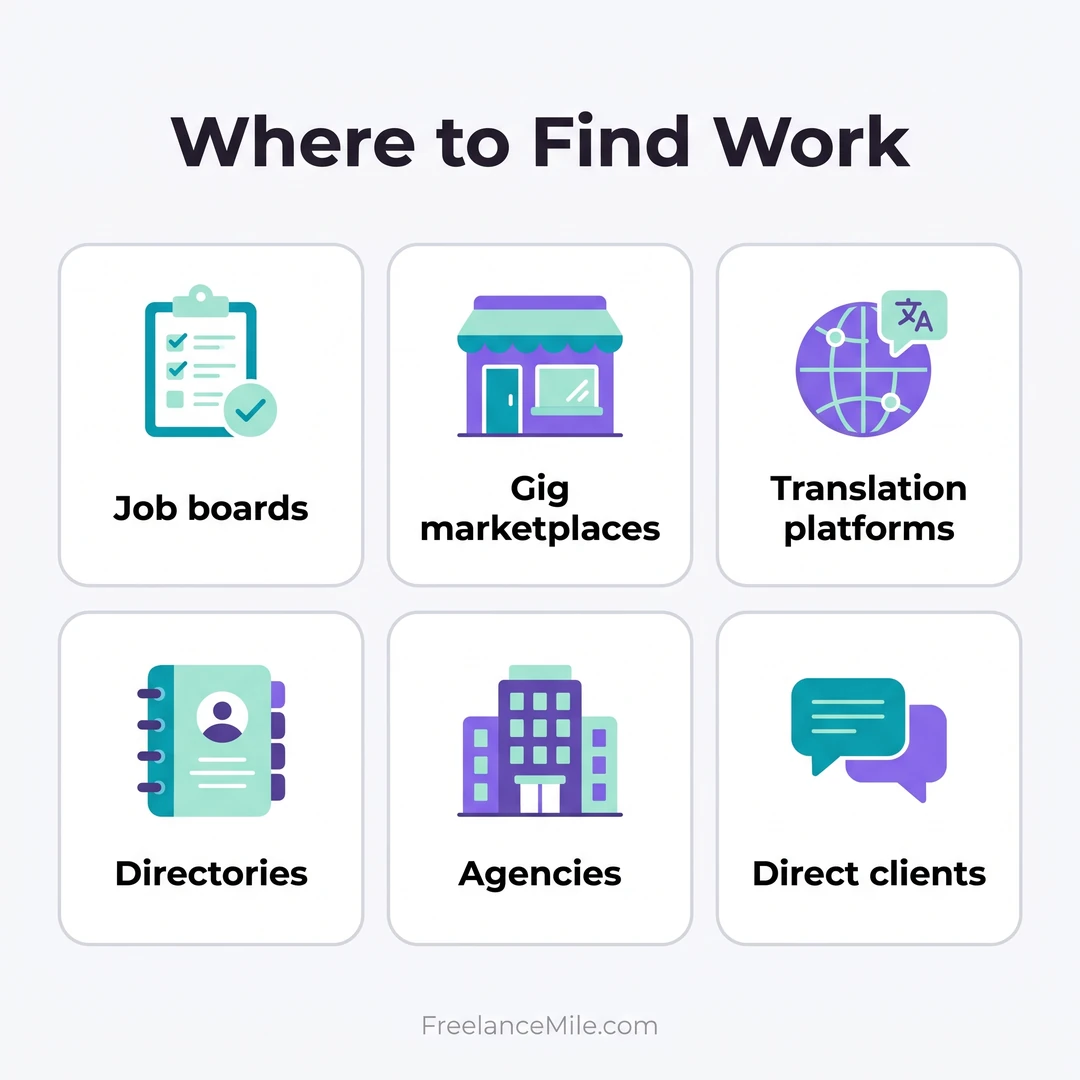
The order below puts general marketplaces first, then translator-specific platforms.
1. Fiverr
Fiverr is a marketplace where you create a gig and clients come to you. That suits translators who can clearly package a service, such as “translate 1,000 words from Spanish to English.”
Fiverr says freelancers receive 80% of a client’s cleared payment, with a 14-day clearing period (Fiverr Help Center).
Beginner tip: start with a narrow gig and a clear word limit, so clients know exactly what they are buying.
2. Upwork
On Upwork you send proposals to client job posts. Upwork says its freelancer service fee ranges from 0% to 15% per contract, and is fixed once the contract begins (Upwork Help).
You see the fee when you submit a proposal. Read our guides on starting on Upwork and whether Upwork is worth it.
3. Freelancer.com
Freelancer.com lets you bid on projects and enter contests. Its fees page says freelancers pay 10% or $5.00, whichever is greater, on fixed-price projects, and 10% on hourly projects (Freelancer.com fees).
The $5 minimum matters on very small jobs, so check the fee before you bid on a short translation.
4. Gengo
Gengo is built for translation. It says you create a free account, take a two-part test and start translating once approved (Gengo).
Gengo says it has a tested pool of 21,000 translators and that you can pick projects and work on your own schedule. Passing its Pro test opens up harder projects at higher reward rates.
5. Smartcat
Smartcat runs a marketplace of language professionals. It says the marketplace has more than 500,000 linguists, and that it also offers a translation management system and CAT tool (Smartcat).
Use it to create a profile and learn professional tools while you build experience.
6. ProZ.com
ProZ.com has a free membership and paid Standard and Plus packages. ProZ says members see member-only jobs and their quotes are seen first (ProZ.com).
The same page says 2,474 jobs were posted on ProZ.com last month, and its Blue Board helps you check clients. Check the current price of each package before you pay.
7. TranslatorsCafe
TranslatorsCafe is a directory of translators, interpreters and translation agencies, with a job board. It says you can offer your services to registered translation agencies.
A profile there costs little time to set up, and it adds another place for clients to find you.
Comparison of the seven platforms
Scroll sideways to see the full table.
| Platform | How you find work | Fee or cost stated by the platform | Good for |
|---|---|---|---|
| Fiverr | Create gigs, clients order | Freelancers receive 80% of cleared payment | Packaged services |
| Upwork | Send proposals | 0% to 15% per contract | Ongoing clients |
| Freelancer.com | Bid and contests | 10% or $5.00 (fixed), 10% (hourly) | Quick first jobs |
| Gengo | Pass test, pick projects | Check Gengo for current rates | Beginner translators |
| Smartcat | Marketplace profile | Check Smartcat for current pricing | Learning pro tools |
| ProZ.com | Directory and job board | Free plus paid packages | Career translators |
| TranslatorsCafe | Directory and job board | Check the site for current plans | Reaching agencies |
Translation agencies and direct clients
BLS says some translators become self-employed by submitting resumes and samples to translation and interpreting companies, which match their skills to assignments.
Others find work through their reputation or referrals from clients and colleagues. Build a short portfolio and ask happy clients to recommend you.
Before you sign, read the contract carefully. Our freelance contract guide lists what to include.
Do you need a translation certification?
BLS says general certification typically is not required for interpreters and translators, though employers may prefer it for some roles. Most states require certification for court interpreters.
In the United States, the American Translators Association offers a three-hour, open-book, proctored certification exam. ATA says it is a credential for experienced translators, and results are pass or fail.
Beginners can start without it, then consider certification once they have steady experience.
How to get your first translation job
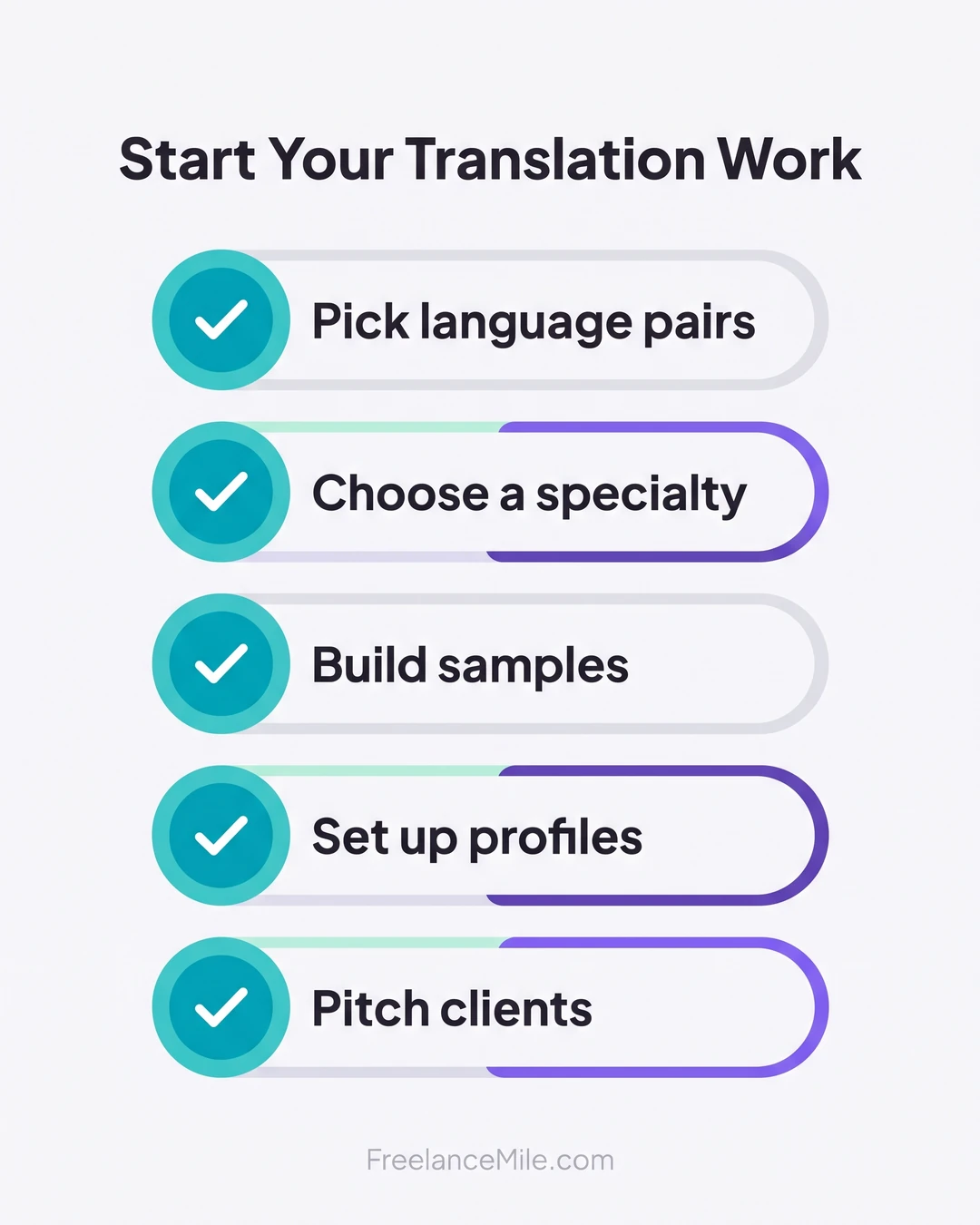
- Pick your language pair. Translate into your strongest language, which is usually your native one.
- Choose a specialty. BLS lists fields such as legal, medical, literary and website localization.
- Build samples. Translate public-domain or self-written texts, and ask a fluent reader to check them.
- Learn a CAT tool. Many platforms and clients expect translation memory tools.
- Set up two profiles. Use one marketplace and one translator-focused platform.
- Set your rates. See how much to charge as a freelancer, then send invoices on time using our invoicing guide.
Pros and cons of freelance translation
- Pro: schedule control. BLS says self-employed translators can set their own schedules.
- Pro: remote work. BLS says translators receive and submit work electronically and may work remotely.
- Con: uneven work. BLS says there can be periods of limited work and periods of long, irregular hours.
- Con: deadlines. BLS says translators must sometimes deal with deadline pressure.
If you are new to freelancing in general, start with how to start freelancing with no experience and what freelancing is.
FAQ
Which freelance translation website is best for beginners?
Gengo is built for translators and tests you before you start, while Fiverr and Upwork let you build reviews on general marketplaces. Many beginners use one of each.
Can I start freelance translation with no experience?
Yes. BLS says experience is not typically required to enter the occupation, but freelancers benefit from it. See the BLS profile.
How much do freelance translators make?
It depends on language, specialty and experience. BLS reports a median of $28.93 an hour for employed interpreters and translators in May 2025, excluding self-employed workers.
Do I need a degree to be a translator?
BLS says interpreters and translators typically need at least a bachelor’s degree, along with proficiency in two languages. Freelancers can still show skill through samples and reviews.
Is machine translation replacing translators?
BLS says AI tools make translators more efficient, but many jobs cannot be entirely automated yet. Learn post-editing alongside translation.
Conclusion
Start small: pick one language pair, build samples and set up two profiles. Compare fees before you bid, and add certification when you have steady experience.