
The best side hustles in Hawaii lean on what the islands do well: visitors, ocean activities, local food and flowers, plus remote work you can do from home. Below are 15 ideas, the state and county rules to check first, and what “passive income” in Hawaii really looks like.
Key takeaways
- Hawaii is one of the most expensive states. BEA ranks it second for 2024 price levels, after California.
- Get a GET license first. Hawaii taxes business activity, including side hustles, through the general excise tax.
- Ocean lessons need permits. Surfing instruction and guided canoe or kayak tours need a state commercial use permit.
- Homemade food is allowed without a food establishment permit if you follow the Department of Health rules.
- Rentals have strict rules. Short-term rentals are taxed and, on Oahu, limited to certain zones.

Why side income matters in Hawaii
BEA’s regional price parities put Hawaii at 110.0 in 2024, meaning prices were about 10% above the national level. Only California was higher among states, at 110.7 (BEA regional price parities).
Hawaii’s minimum wage rose to $16.00 an hour on January 1, 2026, and is set to reach $18.00 on January 1, 2028 (Hawaii Wage Standards Division).
With high prices, many residents look for a second stream of income. The ideas below suit both full-time workers and people who want flexible hours.
Hawaii side hustle checklist
Check these rules before you take your first payment.
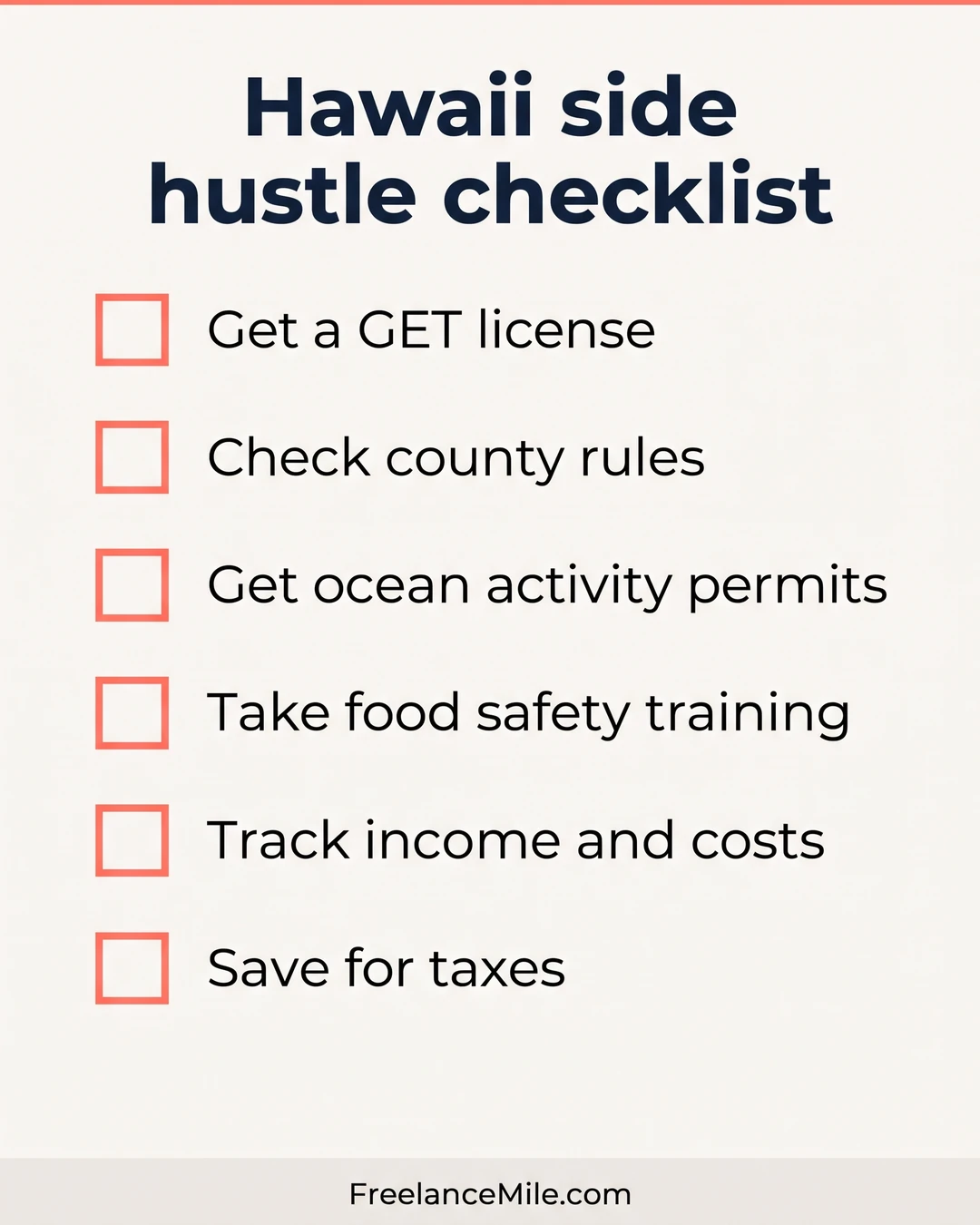
- Get a GET license. The general excise tax applies to business activity in Hawaii. A license costs a one-time $20, and the rate is 4% for most activity, plus a 0.5% county surcharge in all four counties (Hawaii Department of Taxation). Doing business without one can bring a $500 fine, or $2,000 for a cash-based business (Hawaii rental tax page).
- Check county rules, especially for rentals, zoning and events.
- Get ocean activity permits before you teach or guide in the water.
- Take food safety training if you sell homemade food.
- Track income and costs in a separate account.
- Save for taxes from every payment.
15 side hustles in Hawaii
Ideas are grouped by type. Start with one that fits your skills and the time you have.
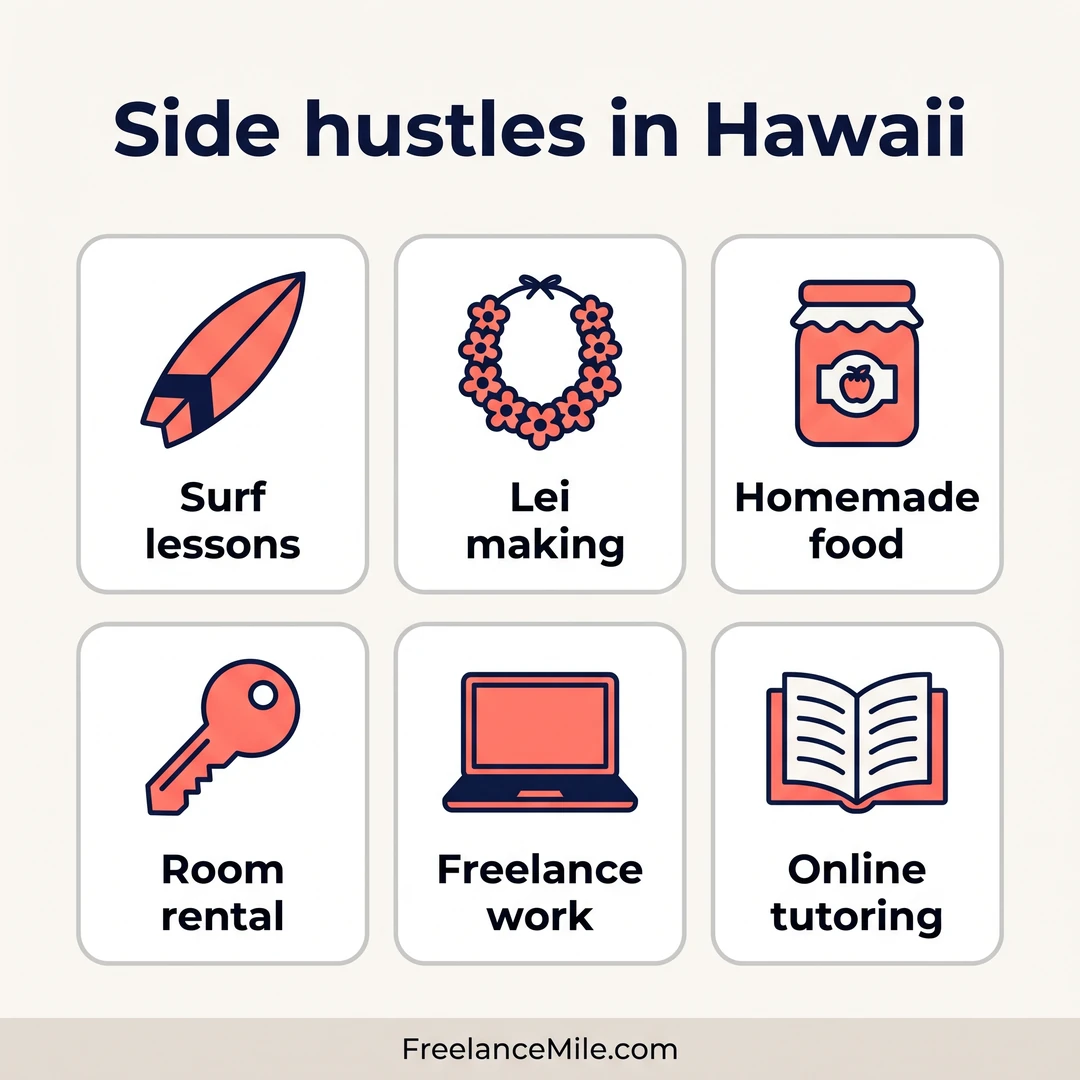
1. Surf lessons
Surf lessons are a classic visitor activity. Hawaii’s Division of Boating and Ocean Recreation (DOBOR) says anyone providing watersports instruction, including surfing, must get a commercial use permit (DLNR commercial boating and ocean recreation).
For permittees operating from state land, DOBOR lists a fee of $300 a month or 3% of gross receipts, whichever is greater. You also need a GET license and commercial insurance to apply.
2. Canoe, kayak and snorkel guiding
Guided canoe and kayak tours and commercial diving operations are on the same DOBOR permit list. Working for an existing permitted operator is an easier way to start.
3. Land tours and hiking guides
If you know local history, food spots or trails, offer small walking or hiking tours. Check whether the trail or land you use needs landowner permission or a permit.
4. Vacation and event photography
Couples, families and visitors book beach photo sessions, and weddings need photographers and helpers (photography side hustle guide).
5. Lei making
Leis are given for graduations, weddings and welcomes. Sell to friends, local shops or event planners, and take custom orders for big days.
6. Homemade food
Since August 24, 2025, Hawaii’s Food Safety Code lets homemade food producers sell to third parties and wholesale certain products. It also covers pickled, fermented or acidified plant foods with a pH at or below 4.2 (Hawaii Department of Health).
Homemade food operators are exempt from a food establishment permit, but they must get food safety certification, have a handwashing sink and label their food (HAR 11-50-3). See more food side hustles.
7. Honey and farm products
Bees, fruit and plants do well in Hawaii. Home-based honey producers follow a separate state law, HRS 328-79, and may not sell to a wholesaler, according to the Department of Health.
8. Crafts at farmers’ markets
Jewelry, prints, soaps and other crafts sell well at markets and craft fairs. Market organizers may ask for their own permits or paperwork.
9. Room rental
Renting a room to a long-term tenant is the closest thing to passive income for many residents. Rental income is subject to Hawaii income tax and GET (Hawaii Department of Taxation).
10. Vacation rental cleaning and co-hosting
Owners need cleaners, turnover help and co-hosts. Rentals of less than 180 consecutive days are also subject to the transient accommodations tax (TAT), and each county adds its own county TAT (Hawaii Department of Taxation).
On Oahu, short-term rentals (under 30 consecutive days) are only allowed in resort-zoned areas and a few apartment-zoned areas, and each unit must be registered (Honolulu Department of Planning and Permitting). Check the rules before you take on a client.
11. Freelance work
Writing, design, bookkeeping and web work can be done from anywhere in the islands. Upwork charges freelancers a service fee of 0% to 15% per contract (Upwork freelancer service fee).
When I hire freelancers on Upwork, ratings, recent reviews and past work drive about 80% of my decision. A few strong samples matter more than a long profile.
12. Virtual assistant
Remote clients anywhere need help with email, scheduling, research and customer support. Agree on working hours up front, since Hawaii is several hours behind the US mainland.
13. Online tutoring
Tutor school subjects, test prep or music lessons online or in person. Parents often prefer local tutors for younger kids.
14. Digital products
Sell printables, planners or Hawaii travel guides online. Etsy charges a $0.20 listing fee and a 6.5% transaction fee, plus payment processing fees (Etsy fee basics).
15. Pet sitting and house sitting
Residents who travel to the mainland need someone to watch pets, plants and homes. Start with neighbors and build reviews.
Quick comparison
Scroll sideways to see the full table.
| Side hustle | Permit or license to check | Startup cost | Best for |
|---|---|---|---|
| Surf lessons | DOBOR commercial use permit, GET | Medium | Strong surfers |
| Lei making | GET license | Low | Crafty people |
| Homemade food | DOH homemade food rules, GET | Low | Home cooks |
| Room rental | GET, income tax | Low if you own | Homeowners |
| Vacation rental cleaning | GET; client must follow STR rules | Low | People with a car |
| Freelance work | GET | Low | Remote skills |
| Online tutoring | GET | Low | Teachers and students |
Passive income in Hawaii: what is realistic
Few side hustles are truly passive. A long-term room rental, digital products and a content site come closest, but each needs setup and ongoing work.
Rental income still needs GET filings, and short-term rentals add TAT and zoning rules. Count those costs before you call any income passive.
Taxes on side hustle income
Besides GET, US side hustle income is subject to federal tax. Self-employment tax is 15.3% and applies once net earnings from self-employment reach $400 (IRS self-employment tax).
You generally need to make estimated tax payments if you expect to owe $1,000 or more when you file (IRS estimated taxes).
For more ideas, see our side hustles guide and AI side hustle ideas.
FAQ
What is the best side hustle in Hawaii?
It depends on your skills. Surf lessons and tours suit ocean lovers, lei making and homemade food suit crafters and cooks, and freelance work suits people with remote skills.
Do I need a license for a side hustle in Hawaii?
Usually yes. Hawaii requires a GET license for business activity, and some work, like surf lessons, needs extra permits.
Can I sell homemade food in Hawaii?
Yes, if you follow the Department of Health homemade food rules, including food safety certification, a handwashing sink and proper labels.
How can I make passive income in Hawaii?
A long-term room rental or digital products come closest. Both still need tax filings and some ongoing work.
What is the minimum wage in Hawaii?
$16.00 an hour since January 1, 2026, rising to $18.00 on January 1, 2028.