Freelancers can protect their mental health by managing workload, setting boundaries, staying connected and getting professional help early.
This guide covers burnout, isolation and income stress, with practical steps based on NIMH and WHO guidance. It is general information, not medical advice.
Key takeaways
- Burnout has a definition. WHO describes burn-out as resulting from chronic workplace stress that has not been successfully managed (WHO).
- Small habits count. NIMH says even small acts of self-care can have a big impact, such as walking, regular meals and a sleep schedule (NIMH).
- Stay connected. The U.S. Surgeon General’s office shares evidence on how social connection affects health (HHS).
- Know when to get help. NIMH advises seeking professional help if severe symptoms last 2 weeks or more.
- Help is available now. In the U.S., call or text 988 to reach the 988 Suicide and Crisis Lifeline (988lifeline.org).
Mental health challenges that come with freelancing
Freelancing gives you control over projects and hours. It can also remove the structure and support that employers provide.
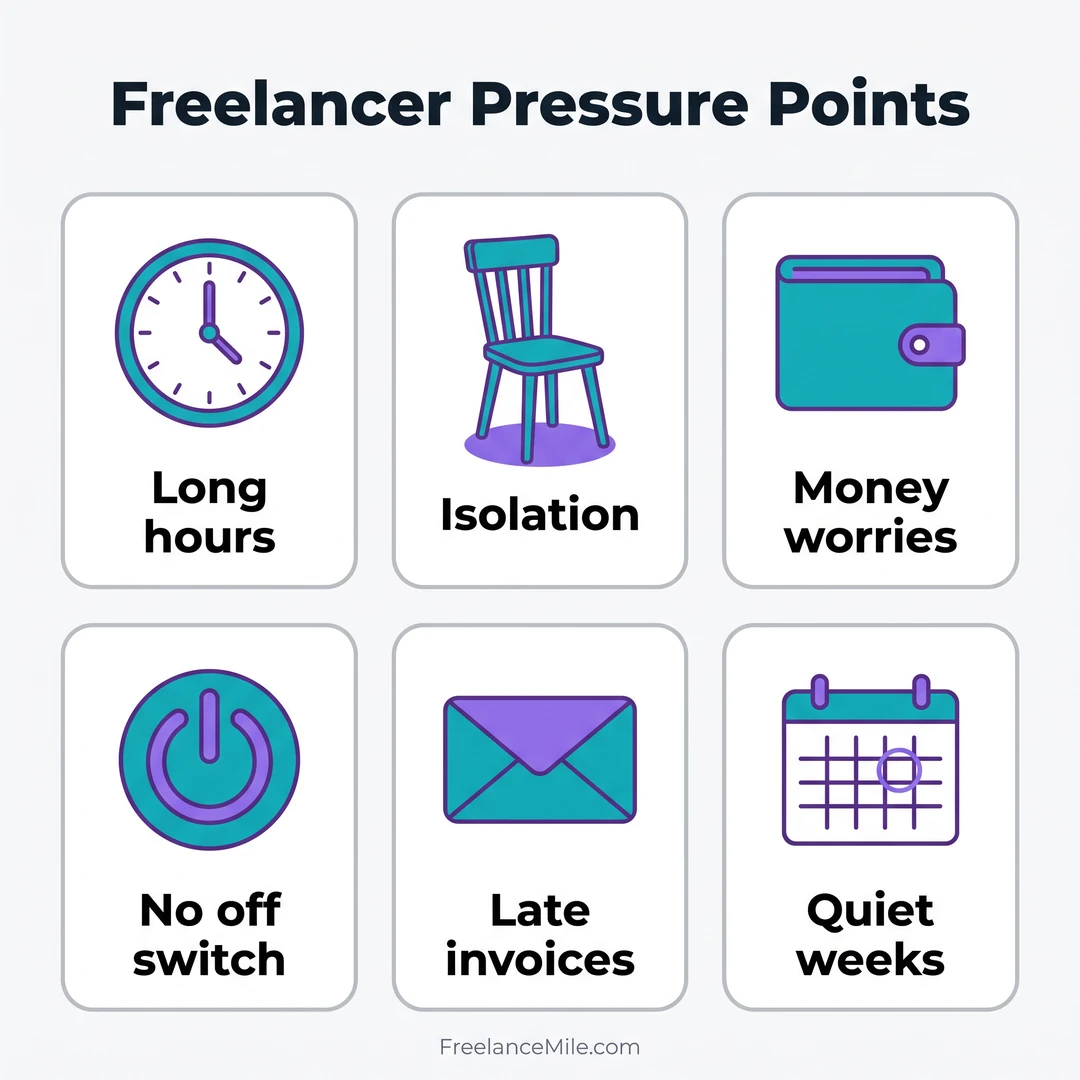
Common pressure points include uneven income, constant client work, no coworkers and no clear end to the workday.
None of this means freelancing is bad for your mental health. It means you need to build your own supports.
Burnout
WHO defines burn-out in ICD-11 as a syndrome resulting from chronic workplace stress that has not been successfully managed (WHO).
WHO says it has three dimensions:
- Feelings of energy depletion or exhaustion.
- More mental distance from your job, or negativity or cynicism about it.
- Reduced professional efficacy.
WHO notes that burn-out refers specifically to the occupational context. It is not classed as a medical condition.
Stress and anxiety
NIMH describes stress as the physical or mental response to an external cause, and anxiety as your body’s reaction to stress that can continue even without a current threat (NIMH).
NIMH says anxiety that does not go away and starts to interfere with your life can affect sleep and your immune, digestive and cardiovascular systems.
Isolation and loneliness
Working alone from home means fewer casual chats. That can feel fine for a while and then slowly wear on you.
The HHS social connection fact cards say social isolation increases the risk of premature mortality by 29%, and that being more socially connected can improve stress responses (HHS).
Money worries
Irregular pay can be a source of stress when you are self-employed. A cash buffer and clear pricing reduce the pressure.
Use our freelance hourly rate calculator to set a rate that covers your costs, time off and slow months.
Warning signs to watch for
NIMH says to seek professional help if you have severe or distressing symptoms that last 2 weeks or more, such as:
- Difficulty sleeping.
- Changes in appetite or unplanned weight changes.
- Difficulty getting out of bed in the morning because of mood.
- Difficulty concentrating.
- Loss of interest in things you usually enjoy.
- Inability to complete usual tasks and activities.
- Feelings of irritability, frustration or restlessness.
The list is from NIMH. If you notice several of these, talk to a primary care provider, who can refer you to a mental health professional.
8 habits that help freelancers
The table summarizes the habits below and what each one targets.
Scroll sideways to see the full table.
| Habit | What it helps with | How to start |
|---|---|---|
| Set work hours | Burnout, no off switch | Pick a stop time and tell clients when you reply |
| Use a written scope | Client demands, extra work | Put deliverables and revisions in your contract |
| Move daily | Stress, mood, energy | NIMH suggests walking 30 minutes a day, in short blocks if needed |
| Protect sleep | Concentration, mood | Keep a regular schedule and cut screens before bed |
| Schedule contact | Isolation | Book a weekly call, coworking day or meetup |
| Build a cash buffer | Income worry | Save part of each payment for slow months |
| Track wins | Self-doubt | Write down what you finished each day |
| Get support early | Burnout, anxiety, low mood | Talk to a doctor or counselor |
Set work hours and boundaries
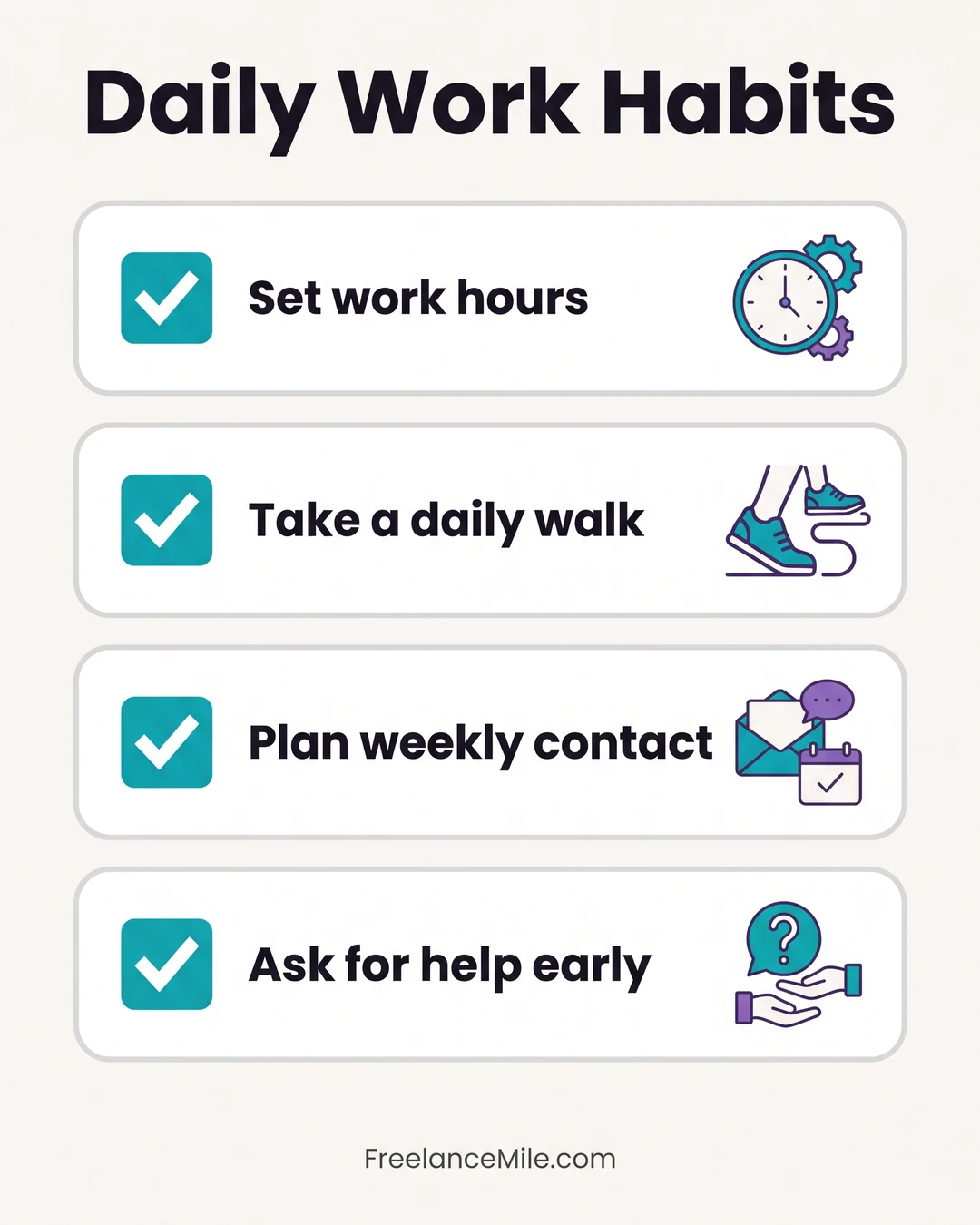
Decide when you start and stop, and when you answer messages. Put this in your client onboarding.
A clear scope and revision limit also prevent overwork. See our freelance contract guide for what to include.
Look after your body
NIMH says to get regular exercise, eat regular meals, stay hydrated and make sleep a priority. It notes that just 30 minutes of walking a day can boost your mood (NIMH).
It also suggests setting goals and priorities, and learning to say no to new tasks when you are taking on too much.
Stay connected
Keep some work and social contact built into your week, for example a coworking space, a freelancer meetup or a regular call with a peer.
NIMH lists staying connected with friends or family as one of its self-care tips (NIMH).
Plan for slow months
Keep a savings buffer and a short list of past clients you can contact when work dries up.
New to the work? Start with what is freelancing.
Getting professional help
NIMH says talk therapy and medication are the two main treatments for anxiety, and many people benefit from a combination (NIMH).
As a freelancer you may not have employer coverage, so plan for it.
HealthCare.gov says all Marketplace plans cover mental health and substance use services as essential health benefits, though your benefits depend on your state and plan (HealthCare.gov).
If you are in immediate distress or thinking about hurting yourself, call or text 988 in the U.S., or chat at 988lifeline.org. The service is free, confidential and available 24/7. Outside the U.S., contact your local emergency number or health service.
FAQ
Why are freelancers prone to burnout?
Without set hours or a manager, work can spread into every part of the day. Irregular income can also push people to say yes to everything.
How can I avoid isolation as a freelancer?
Plan regular contact: coworking, meetups, online communities or scheduled calls. Treat these like client meetings.
When should a freelancer see a professional?
NIMH says to seek help if severe symptoms last 2 weeks or more or get in the way of daily life. Talk to a primary care provider first if you are unsure.
Conclusion
Freelancing works best when you build structure, connection and support around it. Start with one habit this week and add more over time.