For most beginners, yes. You can start freelancing on Upwork‘s free Basic plan and get paid for a skill. Dropshipping needs a store, ad money and margins Shopify puts at 10% to 15% for open-marketplace products.
Dropshipping can still work if you have a budget and the patience to test products. Here’s how the two compare on cost, risk and income, and how to pick.
Key takeaways
- Start-up cost: Upwork’s Basic plan is $0 a month. Shopify’s Basic plan is $39 a month ($29 billed yearly), before ads.
- Margins: Shopify says dropshipping products from open marketplaces typically earn 10% to 15%.
- Fees: Upwork charges freelancers 0% to 15%. Shopify Basic charges 2.9% + 30¢ on online card sales.
- Risk: as the seller of record, a dropshipper handles returns, refunds and support for products they never see.
- Do both: freelance for online stores. Shopify developers on Upwork have a $15 to $29 median hourly rate.
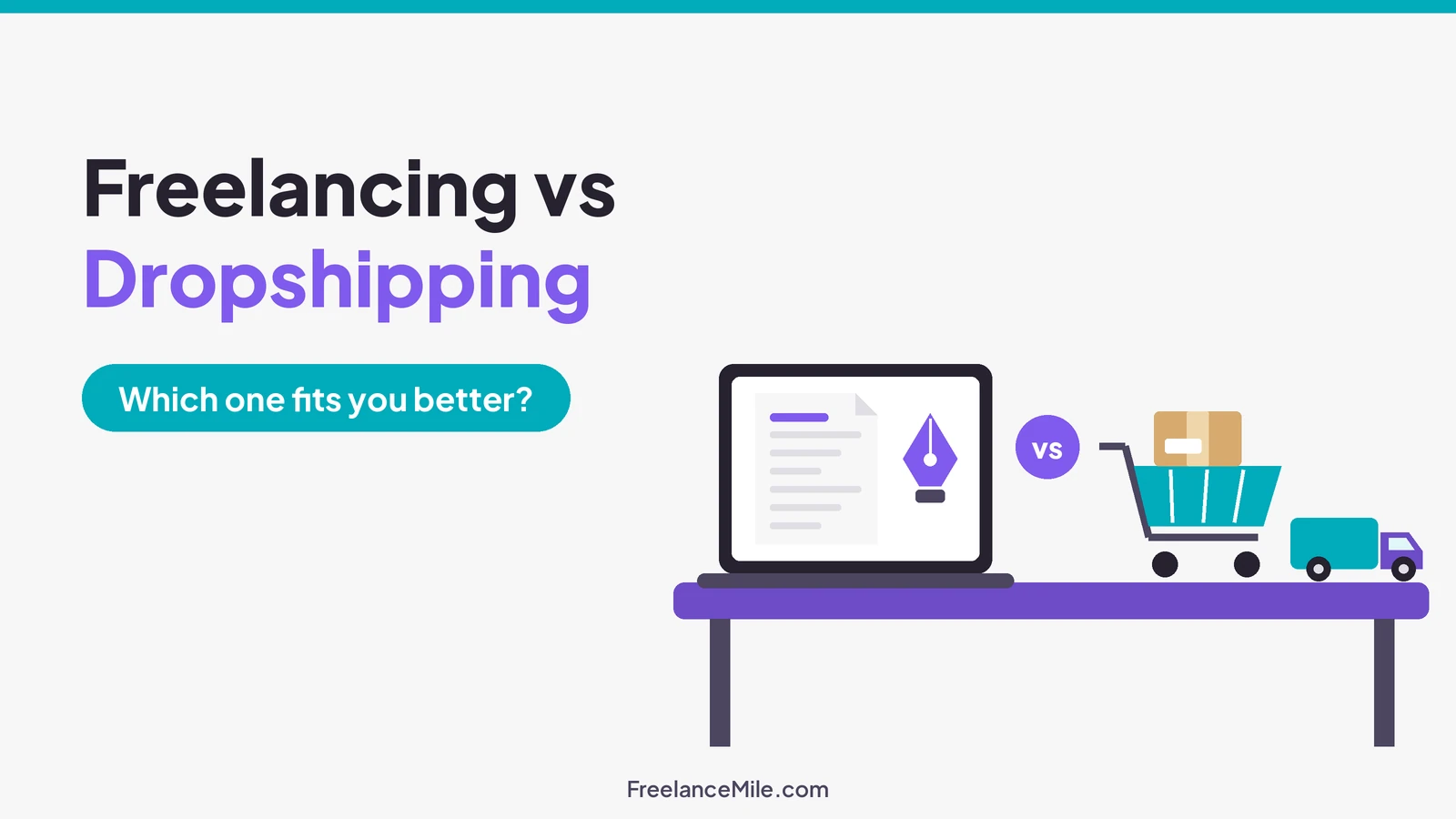
Is freelancing better than dropshipping?
For most people starting with little money, yes. You sell a skill you already have, with no inventory, store or ad spend.
Dropshipping suits you better if you want to build a product brand and can afford to test products and ads before profit arrives.
How do freelancing and dropshipping compare?
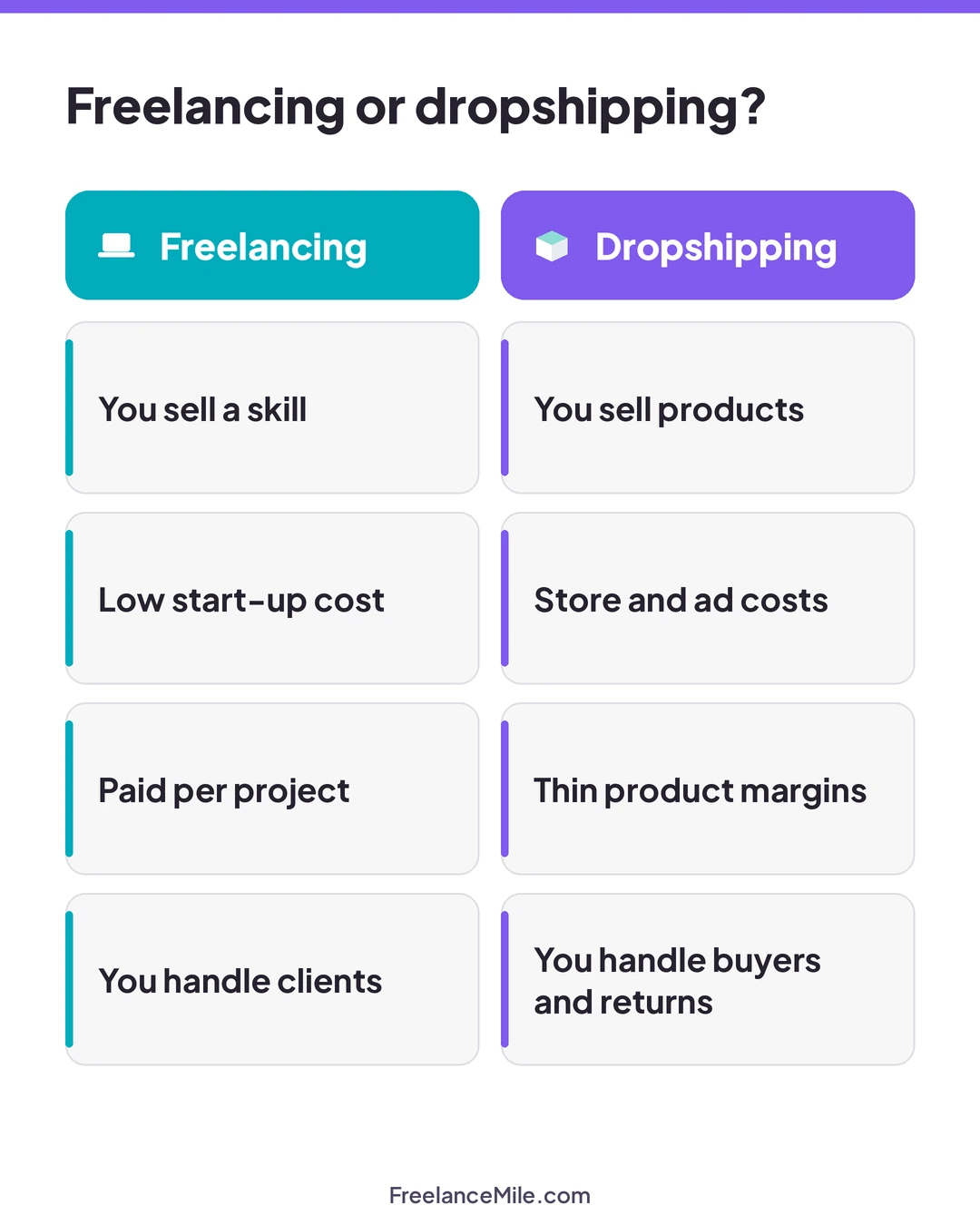
Here are the main differences, using figures from Shopify and Upwork‘s own pages.
Scroll sideways to see the full table.
| Factor | Freelancing | Dropshipping |
|---|---|---|
| What you sell | Your skill or service | Products a supplier ships for you |
| Platform cost to start | Upwork Basic: $0 a month | Shopify Basic: $39 a month, or $29 billed yearly |
| Cost to find work or buyers | Connects to apply, $0.15 each | Ad spend you set |
| Platform fees | Upwork freelancer fee: 0% to 15% | Shopify Basic online cards: 2.9% + 30¢ |
| Typical margin | Your rate minus the platform fee | 10% to 15% for open-marketplace products |
| Who handles customers | You and your client | You, as seller of record: returns, refunds, support |
| Main risk | Gaps between clients | Supplier delays, stock changes and thin margins |
How much does it cost to start each one?
Freelancing can start at almost zero. Dropshipping has a monthly store bill plus ads.
Freelancing start-up costs
Upwork’s freelancer pricing page lists the Basic plan at $0 a month. You spend Connects to apply for jobs, and extra Connects cost $0.15 each.
Freelancer Plus costs $19.99 a month and includes 100 Connects. You don’t need it to start.
Dropshipping start-up costs
Shopify’s Basic plan is $39 a month, or $29 a month billed yearly. New stores get a 3-day free trial, then $1 a month for three months.
Shopify’s own dropshipping guide says to budget for an online store, a domain name and online advertising.
You pay for ads before you know whether a product sells.
Which one earns more money?
Neither has a fixed ceiling. The difference is how each one pays you.
Freelancers earn per hour or per project. Upwork gives this example: on a contract with a 10% fee, a $500 bill pays out $450.
Dropshippers earn the gap between supplier cost and sale price. Shopify says that’s typically 10% to 15% for open-marketplace products.
Shopify says established retailers using supplier networks like Shopify Collective can expect 20% to 50%. At 15%, a $100 sale leaves about $15 before ads and fees.
Is dropshipping riskier than freelancing?
Usually, yes, because you depend on a supplier you don’t control.
Shopify says the seller of record is the point of contact for customers and handles returns and refunds. Its listed drawbacks include inventory volatility, shipping complexities and tariffs.
Card disputes cost money too. Shopify’s help center says when a bank makes a chargeback, it takes the disputed amount and a chargeback fee from you right away.
In the U.S., the Mail, Internet, or Telephone Order Merchandise Rule says you need a reasonable basis to ship within the time you state. If you state none, it’s 30 days.
Freelancing’s main risk is income gaps between clients. Upwork says funds are secured upfront, and disputes can be resolved through Upwork.
How fast can you start earning?
Freelancing can pay from your first project, since there’s no product to test. Winning that first client still takes effort.
When I hire freelancers on Upwork, ratings, recent reviews and past work drive about 80% of my decision. So your first few reviews matter most.
Dropshipping usually means testing products and ads first, and you pay for each test.
Is dropshipping still worth it?
It can be, if you treat it as a real business. Shopify estimates dropshipping will generate more than $476 billion in ecommerce sales in 2026.
A big market doesn’t mean easy profit, though. Be wary of any course that promises passive income from a store.
Still curious? Our guide to dropshipping as a side hustle covers the setup.
Which should you choose: freelancing or dropshipping?
Match the choice to what you have right now: a skill, money or time.
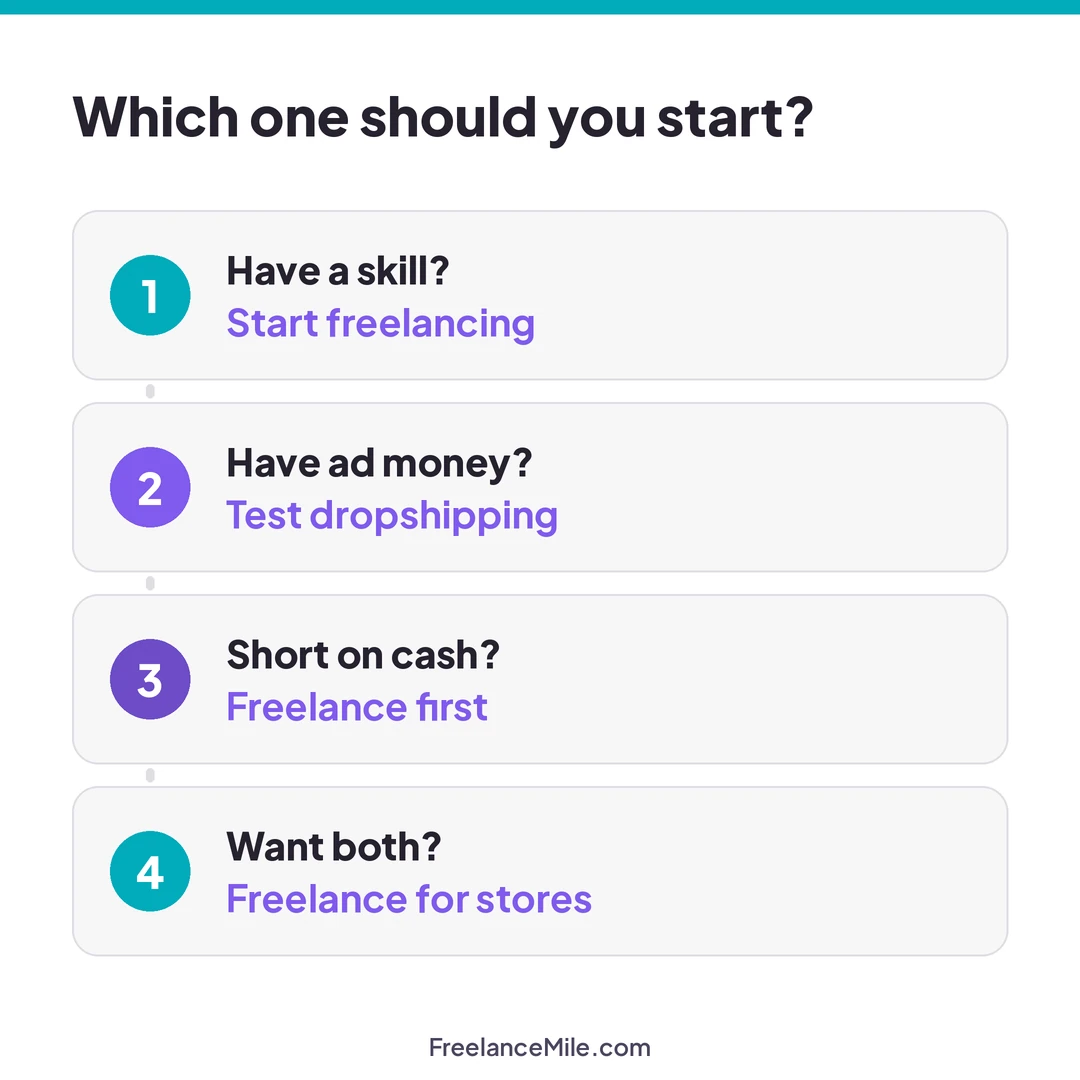
- Have a skill? Start freelancing. Writing, design, ads and development all sell.
- Have ad money? Test dropshipping, and set a loss limit before you start.
- Short on cash? Freelance first, then use what you earn to fund a store later.
- Want both? Freelance for online stores.
Can you combine freelancing and dropshipping?
Yes. Store owners hire freelancers to build stores, write product pages and run ads.
Upwork lists a $15 to $29 median hourly rate for Shopify developers. It says experts charge around $95 an hour.
Product pages are copywriting work, so see how a freelance copywriter gets hired. Want more ideas? Browse side hustles 101.
FAQ
Can you start freelancing with no money?
Yes. Upwork’s Basic plan is free, and you can earn up to 10 Connects a month by completing tasks. Read how to start freelancing with no experience.
How much do you need to start dropshipping?
At least a Shopify plan ($39 a month, or $29 billed yearly, after the $1 intro months), plus a domain and an ad budget.
Is dropshipping legal?
Yes. It’s a normal way to fulfill orders. As the seller of record, you still follow consumer rules, such as the U.S. 30-day shipping rule.
Where do freelancers find their first clients?
Freelance marketplaces are the easiest start. Compare them in our best freelance websites guide.
Sources (checked 28 October 2026)
- Shopify: Pricing (Basic $39/month or $29 yearly, 2.9% + 30¢, 3-day trial then $1/month for three months)
- Shopify: What is dropshipping? (seller of record, 10%-15% margins, 20%-50% via supplier networks, $476 billion in 2026)
- Shopify Help Center: Chargebacks (disputed amount and chargeback fee)
- eCFR: 16 CFR 435.2, Mail, Internet, or Telephone Order Merchandise Rule (stated time or 30 days)
- Upwork: Freelancer pricing (Basic $0, Freelancer Plus $19.99, Connects $0.15, 0%-15% fee)
- Upwork: Shopify developer cost ($15-$29/hr median, expert $95/hr)
What to do next
Write down one skill you could sell this month and one product idea. If you can’t fund ad tests for a few months, start with the skill.