
The Employee Retention Credit (ERC) is effectively closed to new claims. The general IRS deadlines passed on April 15, 2024 (2020 quarters) and April 15, 2025 (2021 quarters).
If you are self-employed, this guide explains who could qualify, what changed in 2025, how to withdraw or fix a claim, and how to spot ERC scams. Every fact comes from IRS.gov.
Key takeaways
- Self-employed with no employees? You were never eligible. The ERC is based on wages paid to employees.
- Your own earnings never counted. Self-employed people can’t include their own self-employment income or wages paid to related people.
- Deadlines have passed. 2020 claims were due April 15, 2024, and 2021 claims April 15, 2025.
- Q3 and Q4 2021 have a stricter cutoff. A 2025 law bars those claims if they were filed after January 31, 2024.
- You can still withdraw an unpaid claim. The IRS claim withdrawal process is open. The Voluntary Disclosure Program closed on November 22, 2024.
ERC status in 2026
The ERC is a refundable tax credit for eligible businesses and tax-exempt groups that had employees during the COVID-19 pandemic (IRS).
It covered qualified wages paid after March 12, 2020, and before January 1, 2022. The IRS says the ERC is not available to individuals.
The IRS says that as of the week ending October 3, 2026, it had about 13,000 ERC claims left in various stages (IRS).
That includes 750 under review, 2,300 pending payment or disallowance, 3,000 under audit, 5,400 awaiting review of disallowance responses and 1,500 with the Independent Office of Appeals.
Could a self-employed person ever claim the ERC?
Only if you had employees. The IRS says a self-employed person with employees who meets the employer rules may qualify based on wages paid to those employees (IRS ERC FAQ).
You can’t count your own self-employment earnings. You also can’t count wages paid to related individuals.
Who the IRS says is not eligible
- Individual taxpayers who are not business owners
- Employees and retirees
- Self-employed individuals who do not have any employees
- Household employers
- Employers that didn’t pay wages to employees during the qualifying periods
- Employers with supply chain problems but no qualifying government order
The IRS notes that scam promoters often target these groups (IRS).
The three ways an employer could qualify
- A full or partial suspension of operations by a COVID-19 government order during 2020 or the first three quarters of 2021
- A large enough decline in gross receipts during 2020 or the first three quarters of 2021
- Status as a recovery startup business in the third or fourth quarter of 2021
Wages reported as payroll costs for Paycheck Protection Program (PPP) loan forgiveness can’t also be used for the ERC (IRS).
ERC deadlines and the 2025 law change
Scroll sideways to see the full table.
Scroll sideways to see the full table.
| Tax period | Claim deadline | Status in November 2026 |
|---|---|---|
| 2020 quarters | April 15, 2024 (generally) | Passed |
| Q1 and Q2 2021 | April 15, 2025 (generally) | Passed |
| Q3 and Q4 2021 | Must have been filed by January 31, 2024 | Later claims barred by law |
The IRS lists the general deadlines in its ERC FAQ.
Section 70605(d) of the One, Big, Beautiful Bill stops the IRS from allowing or refunding ERCs after July 4, 2025, for Q3 and Q4 2021 claims filed after January 31, 2024 (IRS fact sheet FS-2025-07).
If such a claim was already refunded or credited before July 4, 2025, the IRS says that rule generally does not apply. Other compliance work can still lead to a bill.
The same law extends the IRS assessment period for Q3 and Q4 2021 to six years. The Form 941-X instructions say to keep related wage records for at least seven years (IRS).
If you already filed an ERC claim
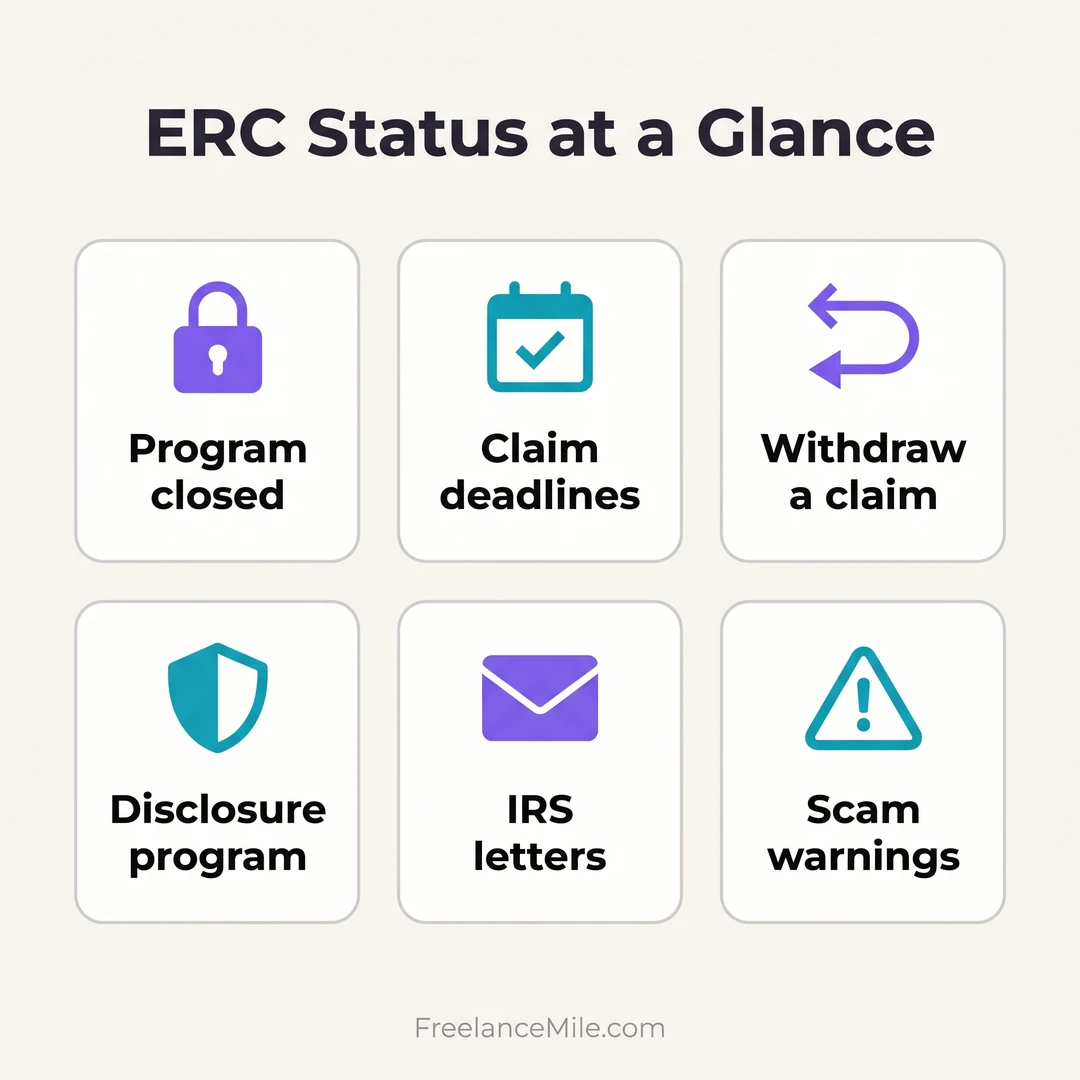
Withdraw a claim that hasn’t been paid
The IRS claim withdrawal process is still open. Withdrawn claims are treated as if they were never filed, and the IRS won’t charge penalties or interest (IRS).
You can use it if all of these apply:
- You claimed the ERC on an adjusted employment tax return (Form 941-X, 943-X, 944-X or CT-1X).
- You filed that return only to claim the ERC, with no other changes.
- You want to withdraw the whole ERC amount for that period.
- The IRS hasn’t paid the claim, or you got a check but haven’t cashed or deposited it.
To withdraw, copy the adjusted return, write “Withdrawn” in the left margin, and have an authorized person sign, date and add their name and title in the right margin.
Fax it to the IRS ERC withdrawal line at 855-738-7609, or mail it to the address in the form instructions.
If you are under audit, send the request to your examiner instead. If you have an uncashed check, write “Void” on the back and mail it with the request to the IRS Cincinnati Refund Inquiry Unit.
The withdrawal only takes effect once you get an IRS acceptance letter.
Reduce a claim instead of withdrawing it
If you still qualify for part of the credit, file a new adjusted return with the correct amount. Don’t send it to the withdrawal fax line (IRS).
The Voluntary Disclosure Program has closed
The first ERC Voluntary Disclosure Program ran from December 22, 2023, to March 22, 2024. The second ran from August 15 to November 22, 2024 (IRS).
The second program let eligible businesses repay 85% of an ERC they weren’t entitled to. It is closed, and the IRS says its page is no longer current.
If the IRS disallowed your claim
You will get Letter 105-C. If you disagree, you can request an appeal with the IRS Independent Office of Appeals or file suit (IRS).
Fix your income tax return
The ERC reduces the wage expense you can deduct for the same period. Sole proprietors may need to amend Form 1040 if they didn’t reduce wages (IRS).
How to spot an ERC scam
The IRS warns about ERC ads on radio, TV and social media, and about fake letters that look like official government mail (IRS).
Watch for these warning signs:
- Unsolicited calls, emails or texts from someone you don’t know
- Claims that they can confirm your eligibility in minutes
- Large upfront fees, or fees based on a percentage of the refund
- Pressure to take a refund anticipation loan
- Telling you that you qualify before discussing your situation
- Saying “every business qualifies” or that you have “nothing to lose”
Anyone who claims the credit incorrectly has to pay it back, and may owe penalties and interest.
To report a promoter, the IRS asks you to send Form 14242 to its Lead Development Center (IRS).
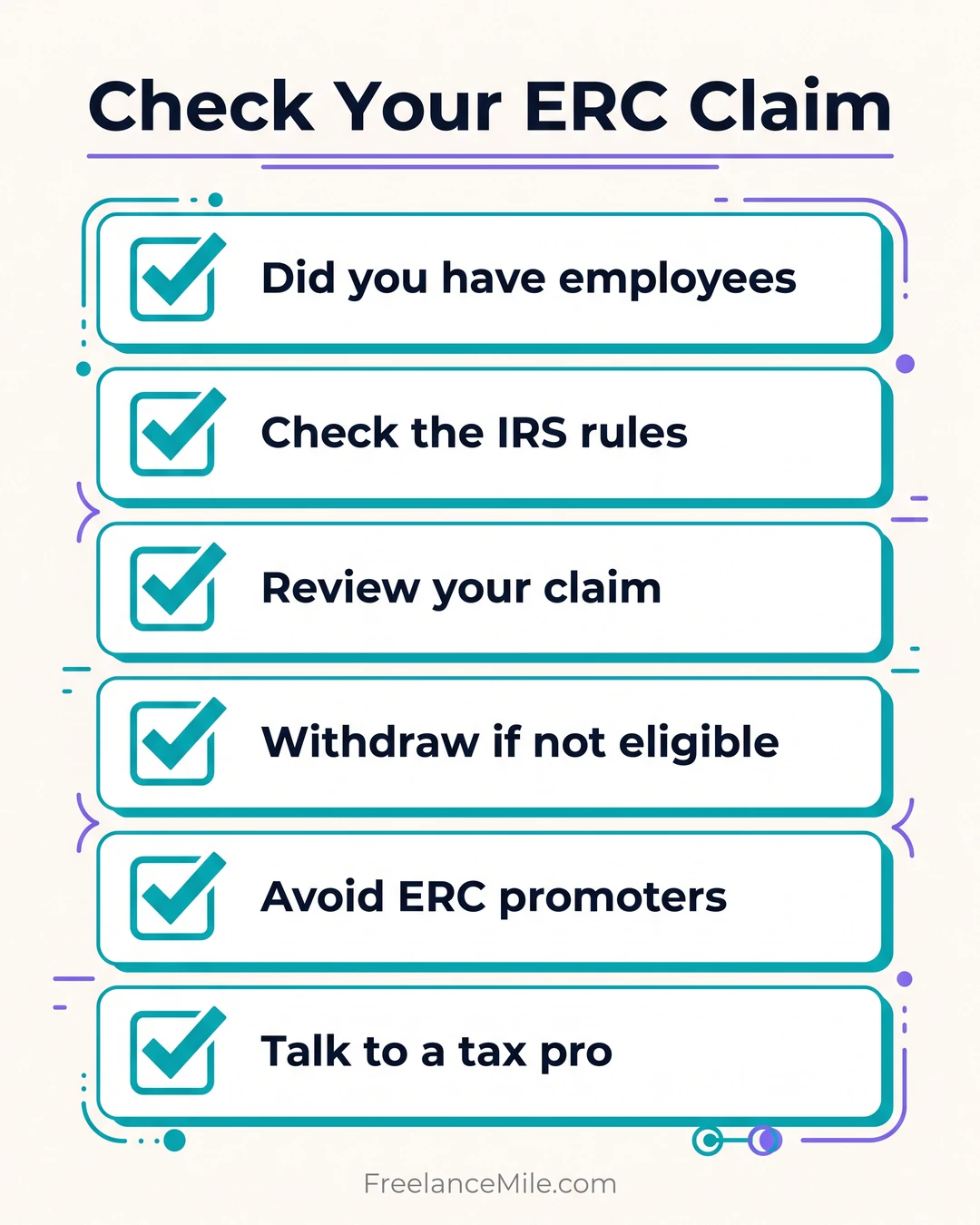
Checklist: what to do now
- Check you had employees. If you didn’t, you were never eligible.
- Find your adjusted returns. Note which quarters you claimed and when you filed.
- Check the IRS signs of an incorrect claim. Use the IRS eligibility checklist on its ERC page.
- Withdraw or correct quickly. Use the withdrawal process if the claim hasn’t been paid.
- Keep records. Keep payroll records, government orders and gross receipts records.
- Work with a trusted tax professional. Avoid anyone who charges a share of the refund.
FAQ
Can I still claim the ERC in 2026?
Generally, no. The general deadlines for 2020 and 2021 quarters have passed, and Q3 and Q4 2021 claims filed after January 31, 2024, are barred by law.
I’m a freelancer with no employees. Did I miss out?
No. The IRS says self-employed people without employees are not eligible (IRS). Any promoter who says otherwise is a red flag.
Is the ERC the same as the “SETC” or self-employed tax credit?
No. The ERC is an employer credit based on employee wages, and your own self-employment income never counted toward it.
Who signs an ERC claim for a sole proprietorship?
The IRS says the individual who owns the business signs it, or an authorized agent with a valid power of attorney (IRS).
Conclusion
For most self-employed people, the ERC is now a closed chapter. The useful steps today are checking past claims, withdrawing or fixing errors, and avoiding scams.
For tax basics as a freelancer, see how to become self-employed and what is freelancing.